
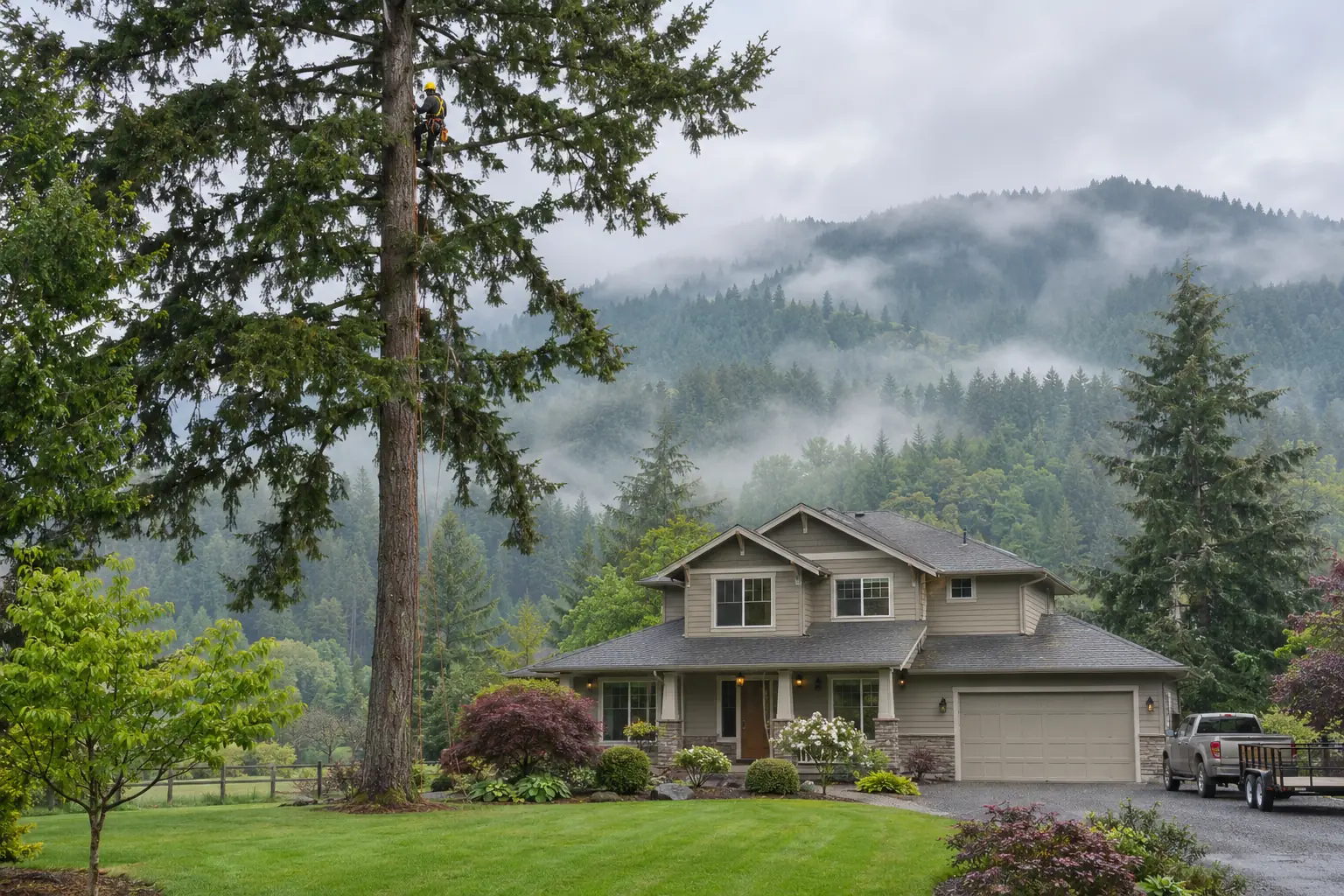
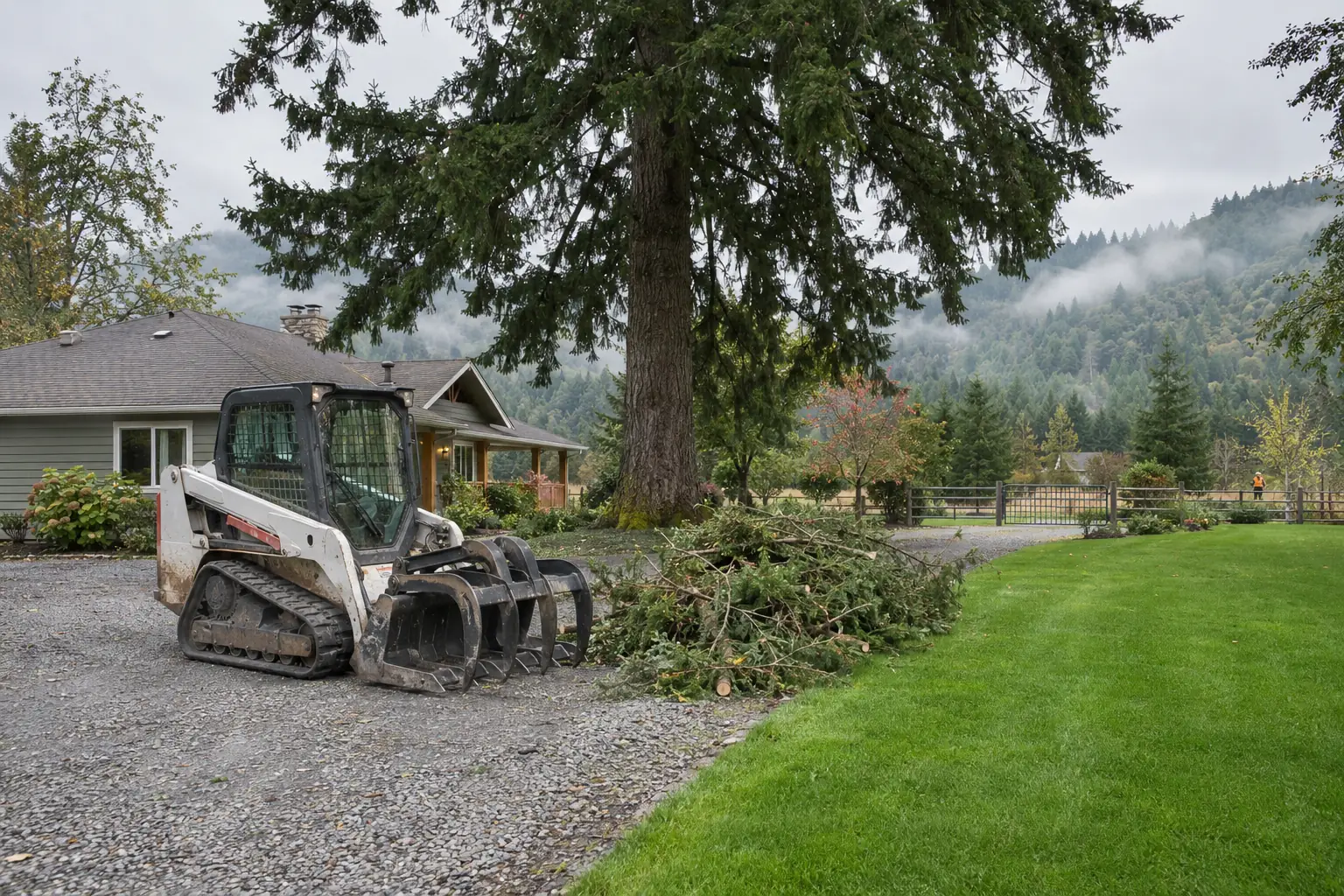
Need a tree service in Grants Pass? The number to dial is (541) 291-5564. It costs nothing, and the call lands with one independent tree company near Grants Pass that holds an Oregon CCB license. From there you set up a visit with that company and ask it for a price in writing for trimming, removal, stump grinding or cleanup. Hiring it is up to you.
Tree Service Grants Pass is a referral service. It does not climb, cut or haul anything, and nobody from this website will show up at your house. Everything on these pages is here to help you ask good questions, understand the local rules and compare what you are offered.
What a tree service does around Grants Pass
A tree service is a company that prunes, removes and cleans up after trees, with the gear and training to work at height and near buildings. Around Grants Pass that mostly means tall conifers on older lots, native oaks on rural acreage and a lot of brush on the hillsides around the valley.
Most calls fall into a handful of jobs:
- Pruning and trimming. Thinning a crowded crown, cutting dead wood out of a tree over the roof, raising low limbs over a driveway or lifting branches off the house.
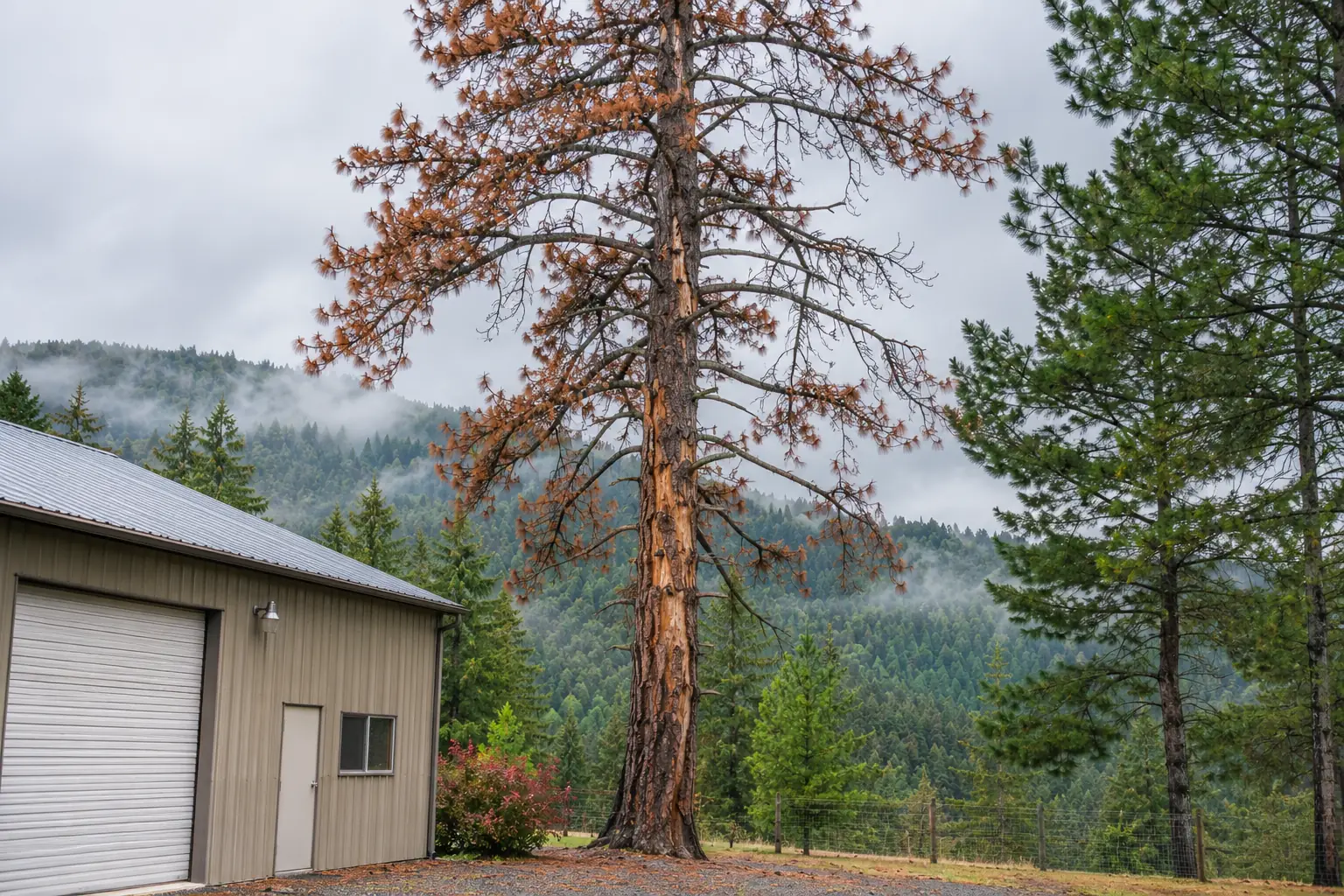
- Taking a tree down. A dead pine, a fir that has started to lean, or a tree that simply grew too big for the spot it was planted in.
- Grinding the stump. Most removals leave a stump behind unless you pay to have it ground out.
- Storm cleanup. Broken tops, split trunks and uprooted trees after wind, ice or wet snow.
- Checking a tree for risk. Looking for rot, cracks, root damage and dead limbs before something gives way.
- Clearing land and brush. Opening up a building site, a pasture edge or the ground around a house before fire season.
A good tree service also tells you when not to cut. Plenty of trees that look rough after a hard summer only need some dead wood taken out, and a careful company will say so instead of selling you a removal.
How one free call works
The call takes a few minutes, and after it you deal only with the tree company. This is the full process:
- You describe the job. Dial (541) 291-5564 or fill in the form. Mention your town, the kind of tree if you know it, what worries you about it and anything nearby such as a roof, a fence or wires.
- You are connected. Your request is passed to one independent tree service based in the area and licensed by the Oregon Construction Contractors Board.
- You set up the visit. Agree a time with the company, find out if the estimate costs anything for your job, and ask for a price on paper once it has inspected the tree on site. Accept it, turn it down or collect other quotes first.
The price, the date, the cleanup and the payment terms are all settled between you and that company. The how it works page goes through each step, and the contact page covers questions about the website.
Why the call is free
The tree company pays Tree Service Grants Pass for referrals. You pay this site nothing, ever. The fee is part of the company's cost of finding customers, the same way an advertisement would be, and you have no duty to hire it. The referral disclosure has the full arrangement in writing.
Since money changes hands for the introduction, treat it like any contractor you found on your own. Check the license, ask about insurance and get the price on paper. The checklist further down this page shows how.
Jobs a Grants Pass tree service can take on
Every job below can be requested with the same free call. Each link opens a page with more detail about that kind of work in Grants Pass.
Tree trimming. Pruning for clearance, safety and the health of the tree. Good pruning removes the right branches at the right point and leaves the tree's natural shape. Ask the company to avoid topping, which leaves stubs that rot and sprout weak regrowth.
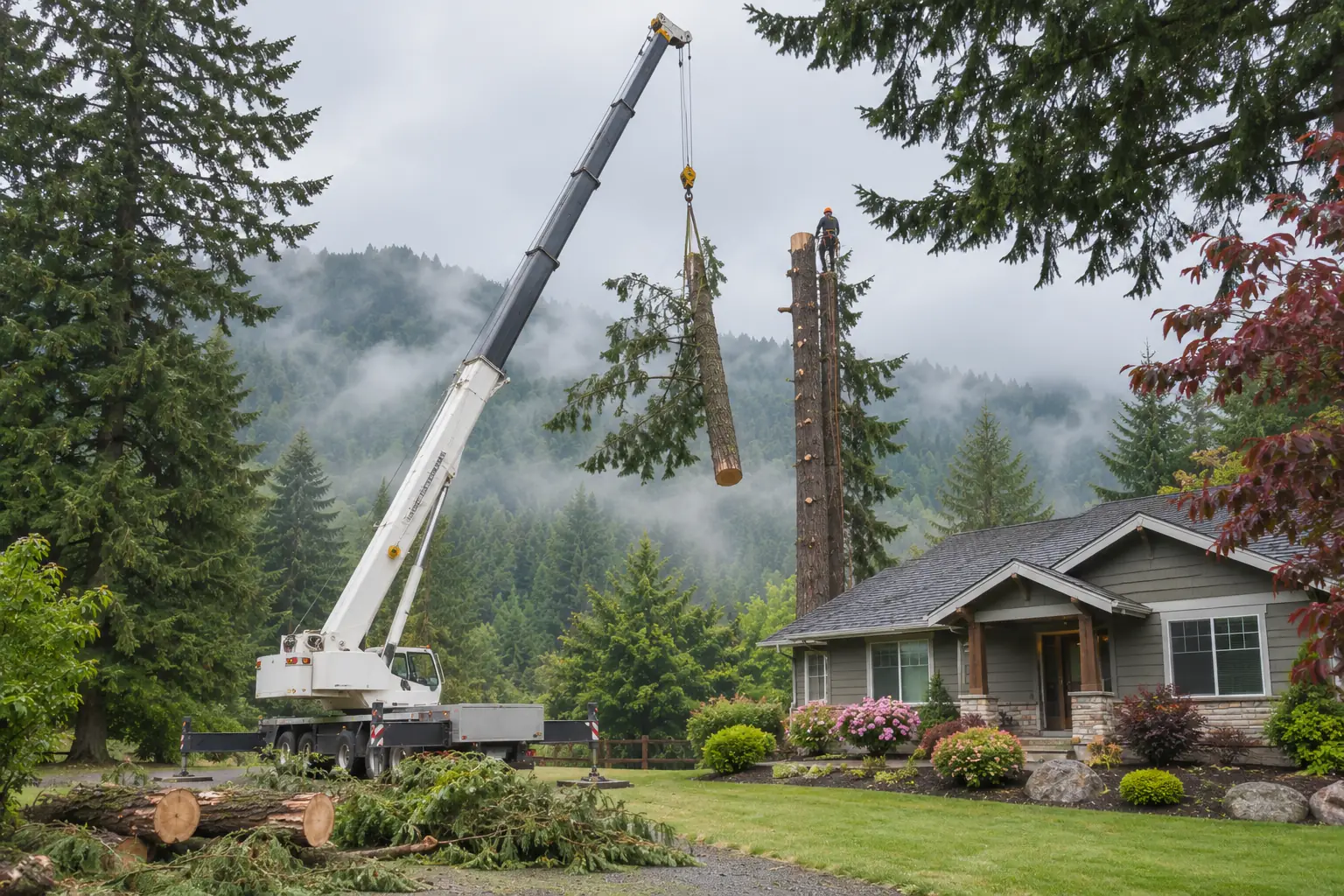
Tree removal. Taking a tree down whole when there is room to drop it, or piece by piece with ropes, a lift or a crane when there is not. Big Douglas fir and ponderosa pine near houses are the jobs that need the most planning.
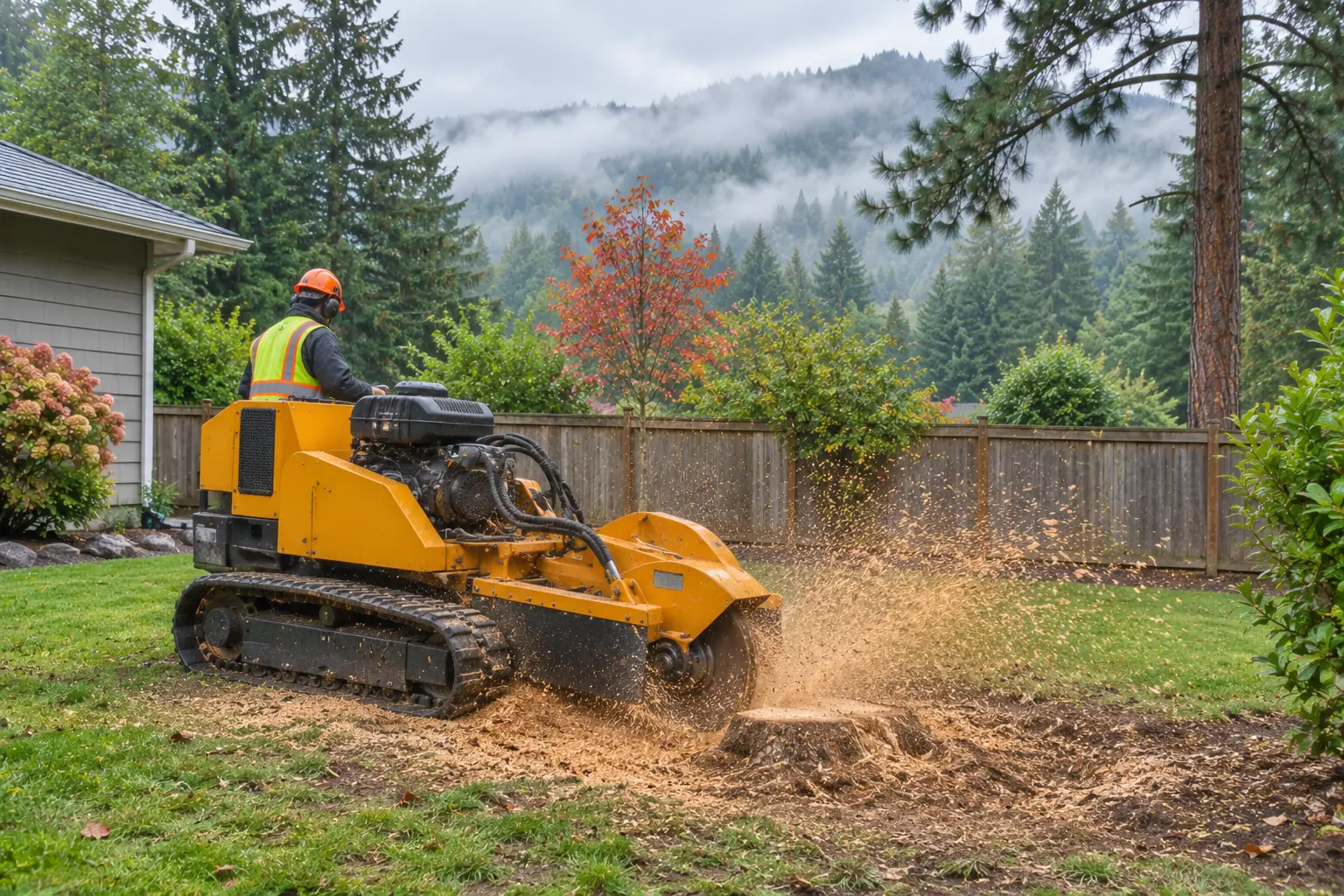
Stump grinding. A grinding wheel cuts the stump into chips to a depth of several inches, so you can replant, lay sod or set pavers. Ask whether the chips stay or go, and how deep the grind will be.
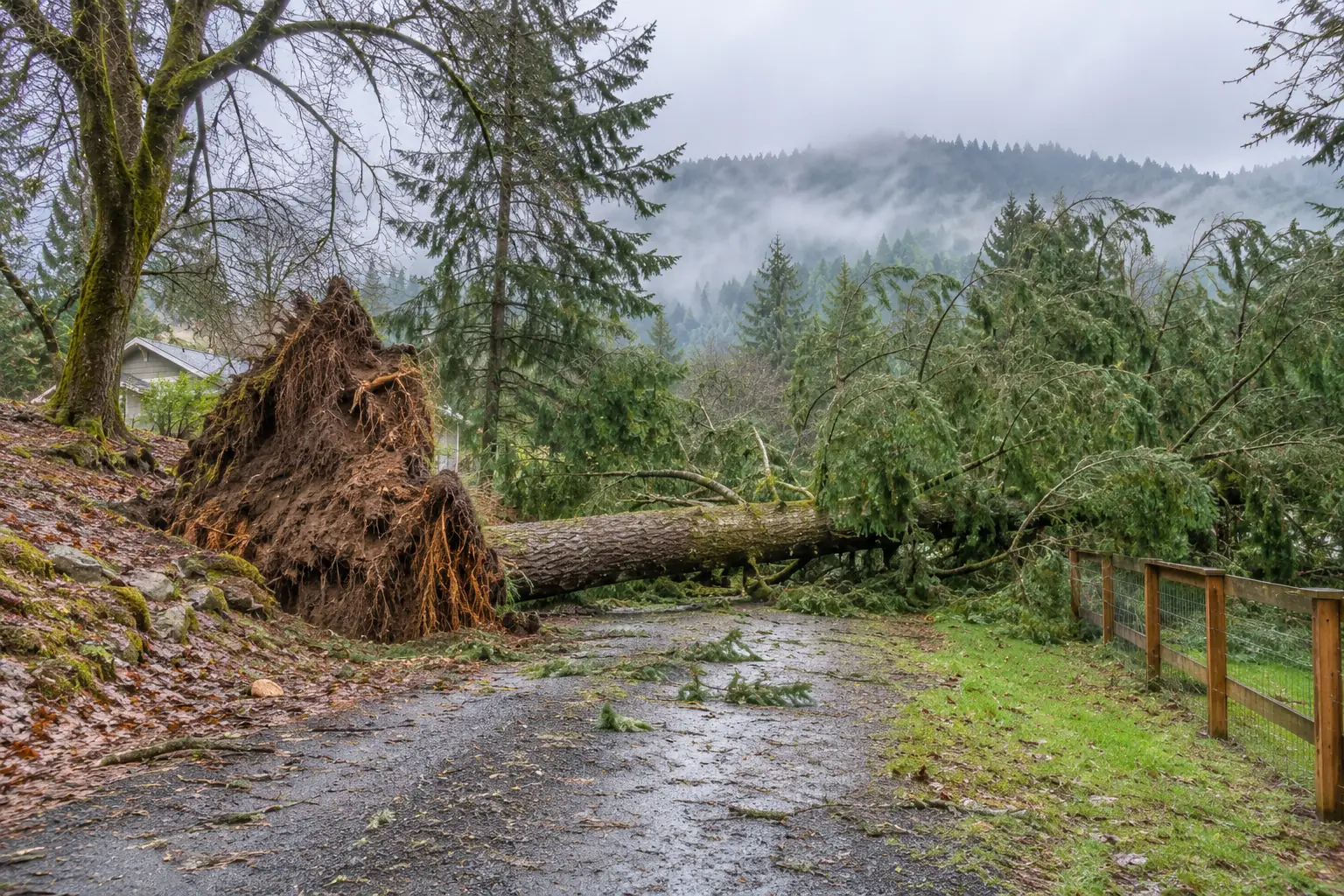
Storm and emergency work. Getting a fallen or split tree off a house, a car or a driveway and making what is left safe. This page also explains what counts as an emergency and what can wait.
Hazard tree checks. An inspection of a tree you are unsure about, ideally by someone trained in tree risk assessment. The answer may be pruning, cabling, watching the tree for another season or taking it down.
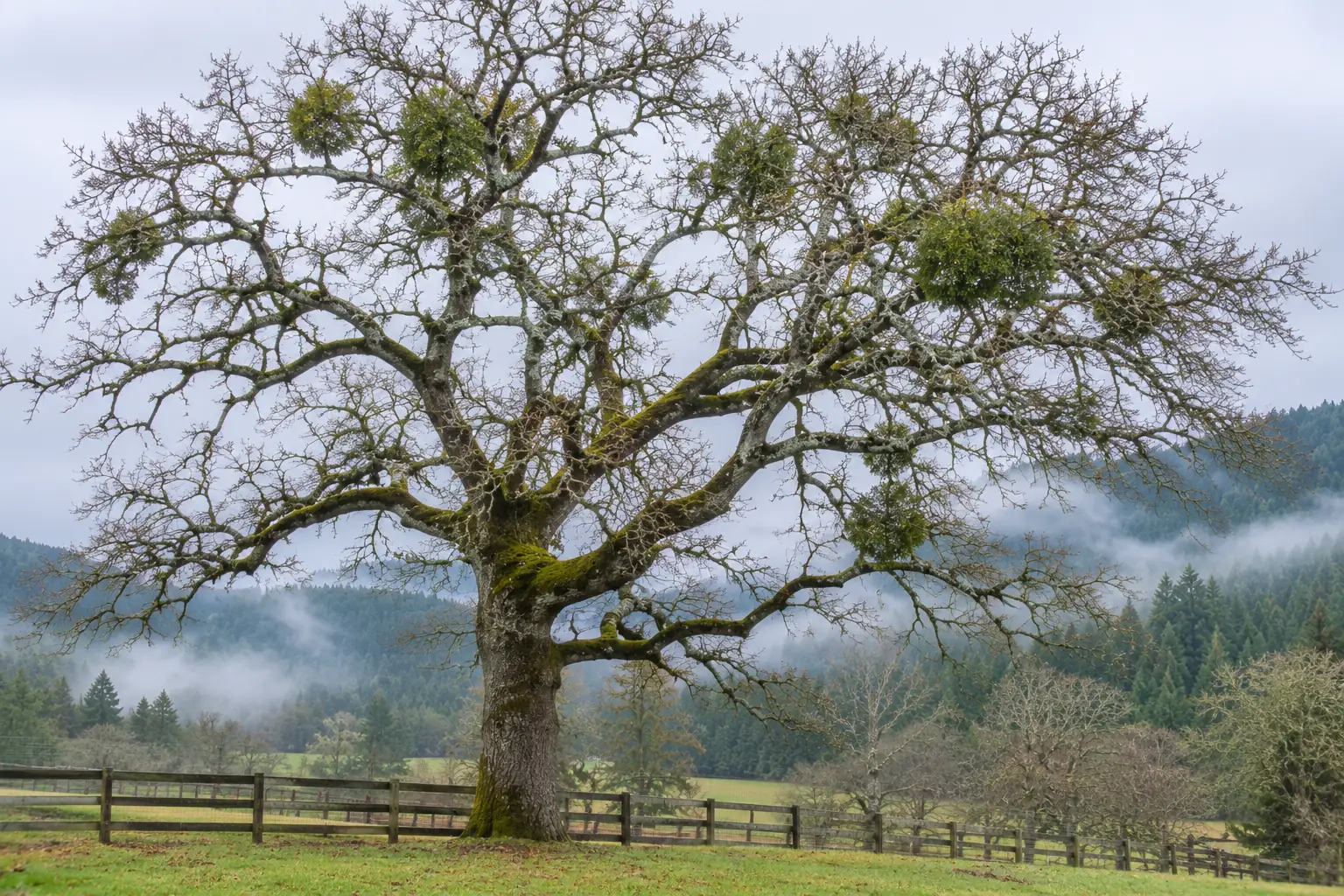
Oak tree care. Pruning and care for Oregon white oak and California black oak, which handle cuts and soil changes differently from conifers. Mistletoe and root damage from construction are the common problems.
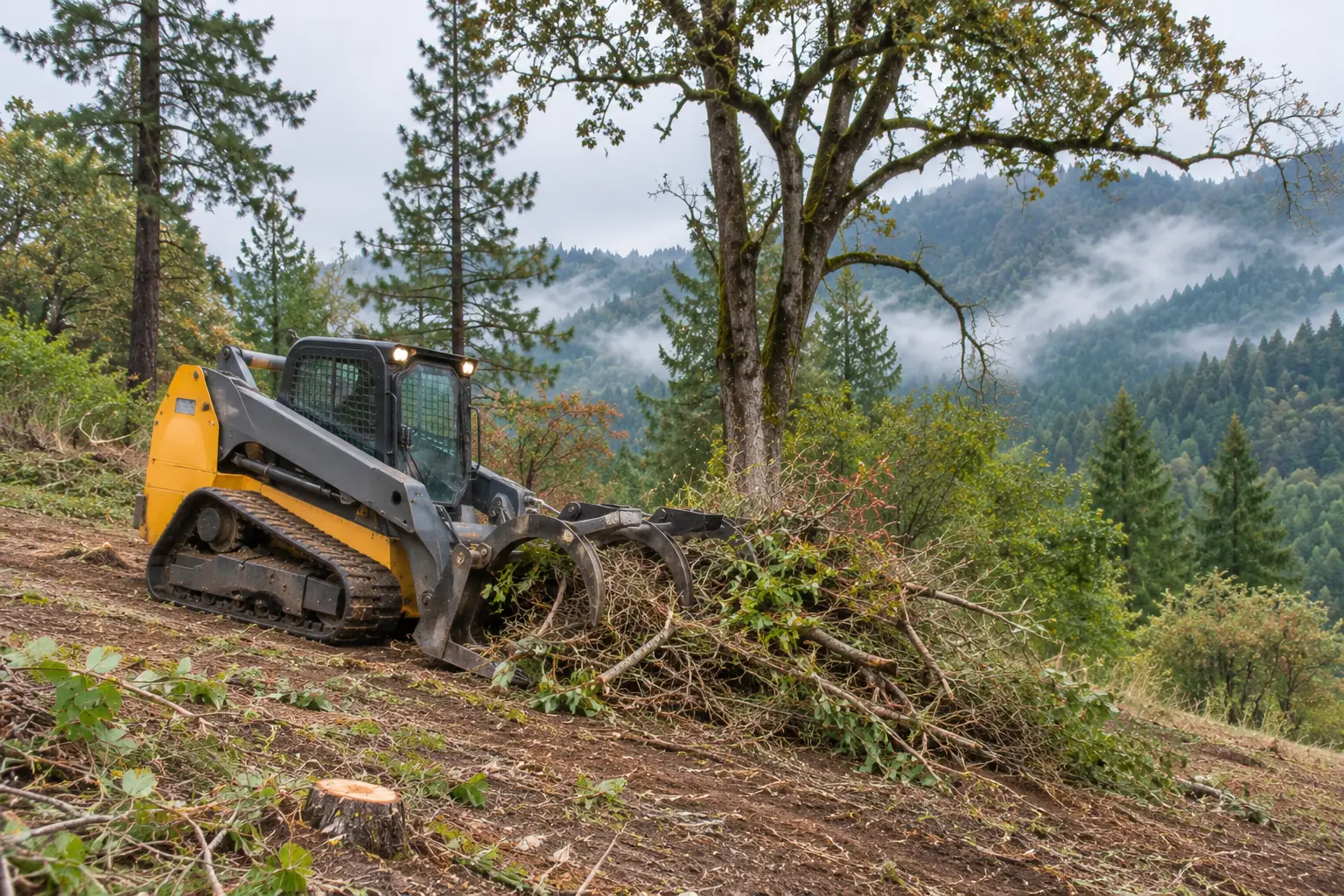
Lot clearing. Removing trees and brush from a building site, a driveway route or an overgrown parcel, often with a track loader or a mulcher.
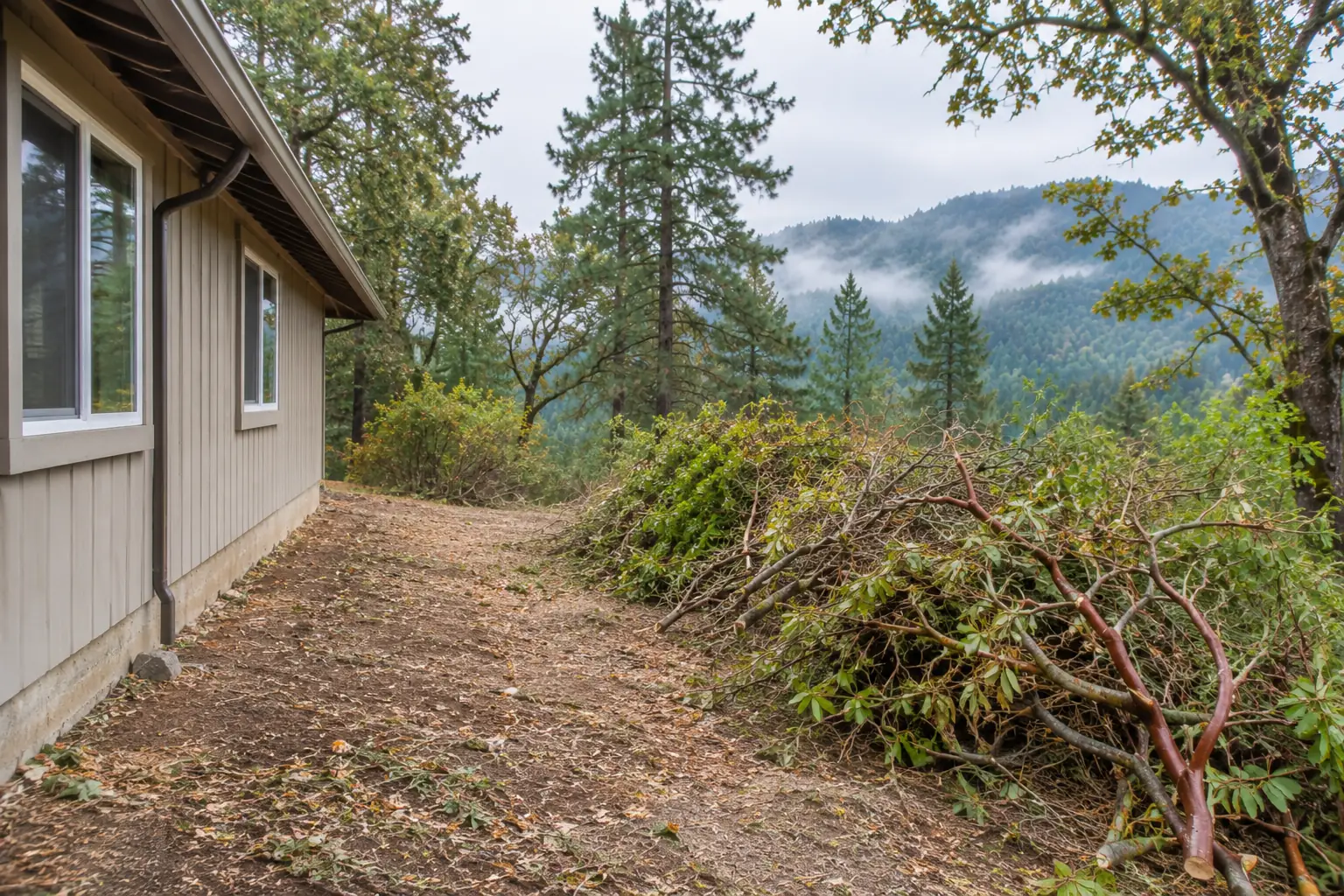
Brush removal. Cutting back manzanita, blackberry, poison oak and small trees, usually to open up access or to make space around a house before fire season.
Arborists, credentials and the right questions
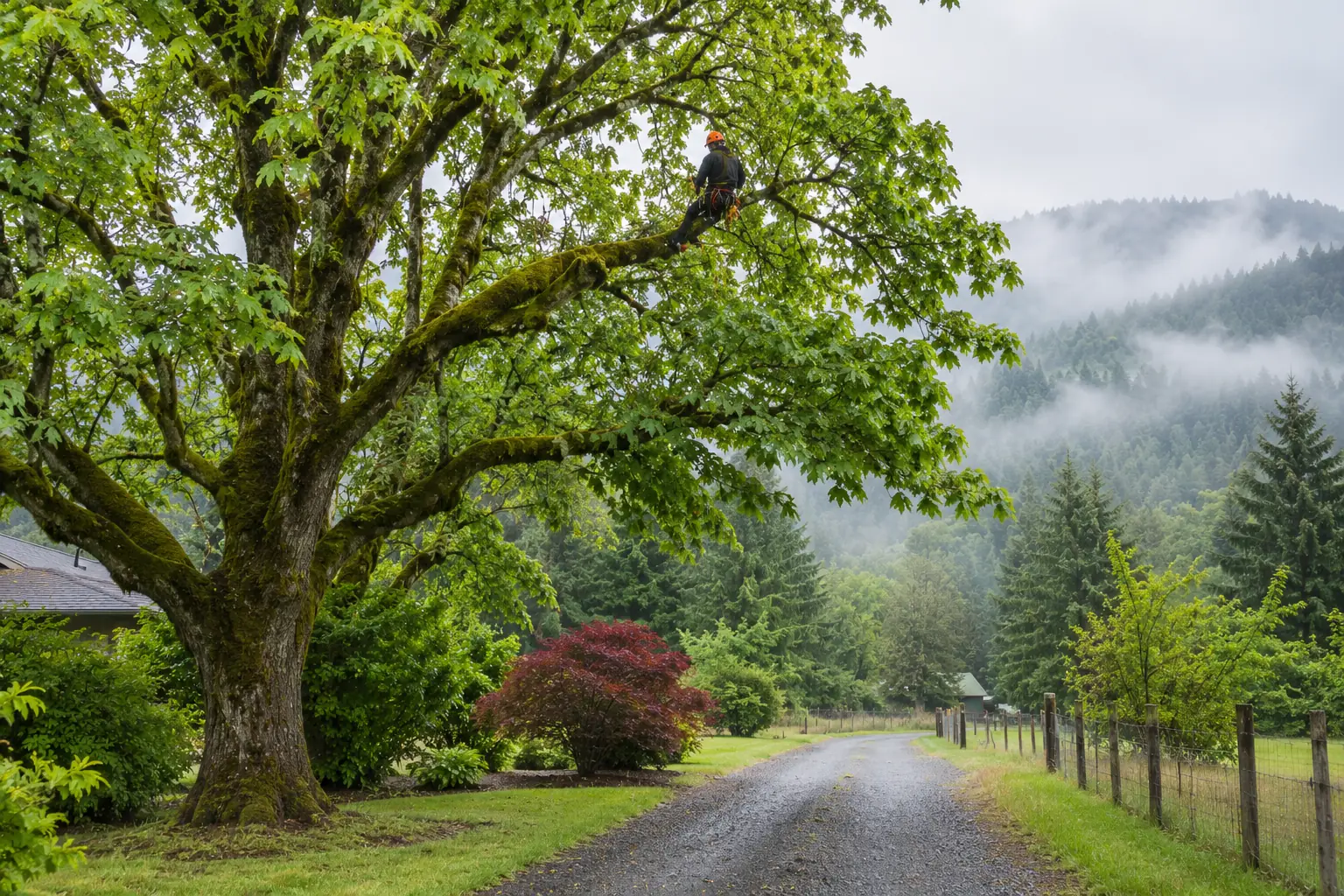
Arborists specialize in the care of single trees rather than whole forests. Anyone can use the word, so the useful question is which credential a person holds and whether you can check it.
The most common credential is ISA Certified Arborist, granted by the International Society of Arboriculture. ISA describes holders as people trained and knowledgeable in all parts of arboriculture, and the program is accredited by the ANSI National Accreditation Board. Holders keep it by earning continuing education credits.
For a tree that might fall, ask about the Tree Risk Assessment Qualification, or TRAQ. According to ISA's TRAQ page, it covers gathering information about a tree, judging its risk and recommending ways to reduce that risk. Candidates take a two-day course and a half-day of written and field testing, and they must retrain and retest every seven years.
You can confirm an ISA credential with the ISA credential lookup. Here is what to ask a Grants Pass tree company:
- Who will look at the tree, and does that person hold an ISA credential?
- Will a certified arborist be on the crew, or only at the estimate visit?
- For a tree near your house, is the advice coming from someone with TRAQ?
- For a street tree inside city limits, is the company on the city's prequalified list?
This site makes no claim that the company you reach holds any ISA credential. Treat the list above as questions to ask, and check the answers yourself.
What tree service costs in Grants Pass
Tree work is priced per job, and most single trees fall somewhere between a couple of hundred dollars and a little over a thousand. No public source tracks prices in Grants Pass alone, so the table uses national cost guides with the date each one was last updated. Your written estimate is the figure that matters.
| Source | Work | Low end | High end |
|---|---|---|---|
| LawnStarter trimming guide | Pruning a single tree, typical | $430 | $640 |
| LawnStarter trimming guide | Pruning a tree taller than 60 feet | $475 | $1,835 |
| LawnStarter removal guide | Taking down a typical tree | $385 | $1,070 |
| LawnStarter removal guide | Grinding out a stump | $158 | $450 |
| This Old House | Taking down a tree under 30 feet | $150 | $450 |
| This Old House | Taking down a tree of 30 to 60 feet | $450 | $1,200 |
| This Old House | Taking down a tree taller than 80 feet | $1,000 | $2,000 |
| This Old House | Emergency removal | not given | $5,000 |
Sources and update dates: the LawnStarter trimming guide was updated September 24, 2026, the LawnStarter removal guide on October 5, 2026, and the This Old House removal guide on March 5, 2026.
What moves a Grants Pass quote up or down:
- Height and trunk size. A 90-foot fir takes far more rope work and cleanup than an ornamental plum.
- What sits under the tree. Roofs, fences, septic fields and wires all mean smaller pieces and slower lowering.
- Getting in. A long gravel road, a gate too narrow for a chipper or a steep backyard adds labor.
- Wood and debris. Hauling everything away costs more than leaving rounds stacked for firewood.
- Timing. After a windstorm, companies are busy and urgent calls cost more.
To spend less: group several trees into one visit, keep the firewood, ask for the stump to be ground only if you need the space, and book pruning in the slow months instead of waiting for a limb to fail. The full Grants Pass tree service cost guide has more ranges and a list of what each estimate should spell out.
Vetting a tree company in ten minutes
Checking a company takes about ten minutes, and it is worth doing every time, including for the business this referral puts you in touch with. Start with the license.
- Look up the license. Tree removal and stump grinding in Oregon generally call for a license from the Construction Contractors Board or the Landscape Contractors Board, according to the LCB's tree work FAQ. Search the company on the Oregon CCB license search. The CCB says the search shows whether a contractor is active and bonded, along with complaint history from the past ten years. You can also call the CCB at 503-378-4621.
- Ask for proof of insurance. Request a certificate of liability insurance in the company's own name, and ask whether its workers are covered by workers' compensation. The CCB record shows some of this too.
- Get it in writing. The CCB's consumer page says construction agreements over $2,000 must be in writing. A written estimate for any tree job should name the trees, the work, the cleanup, the stump and the price.
- Ask who is doing the work. Find out whether the crew belongs to the company or to a subcontractor, and who is in charge on the day.
- Ask about credentials. An ISA Certified Arborist on staff is a good sign, and TRAQ matters for risk calls.
Warning signs worth walking away from:
- A crew that shows up uninvited after a storm and wants to start today.
- A request for most of the money up front, or cash only.
- No license number, or a number that does not match the business name.
- Advice to top a healthy tree.
- A price given over the phone without anyone seeing the tree.
Storms, emergencies and power lines
Treat it as an emergency when a tree or a heavy limb is already on something, is blocking the way in or out, or could fall onto people or a building right now. If that is your situation, call (541) 291-5564, say it is urgent and ask whether the company can take it. This website has no say over how soon anyone can get there. If a wire is part of it, a tree company is the third call, behind 911 and Pacific Power.
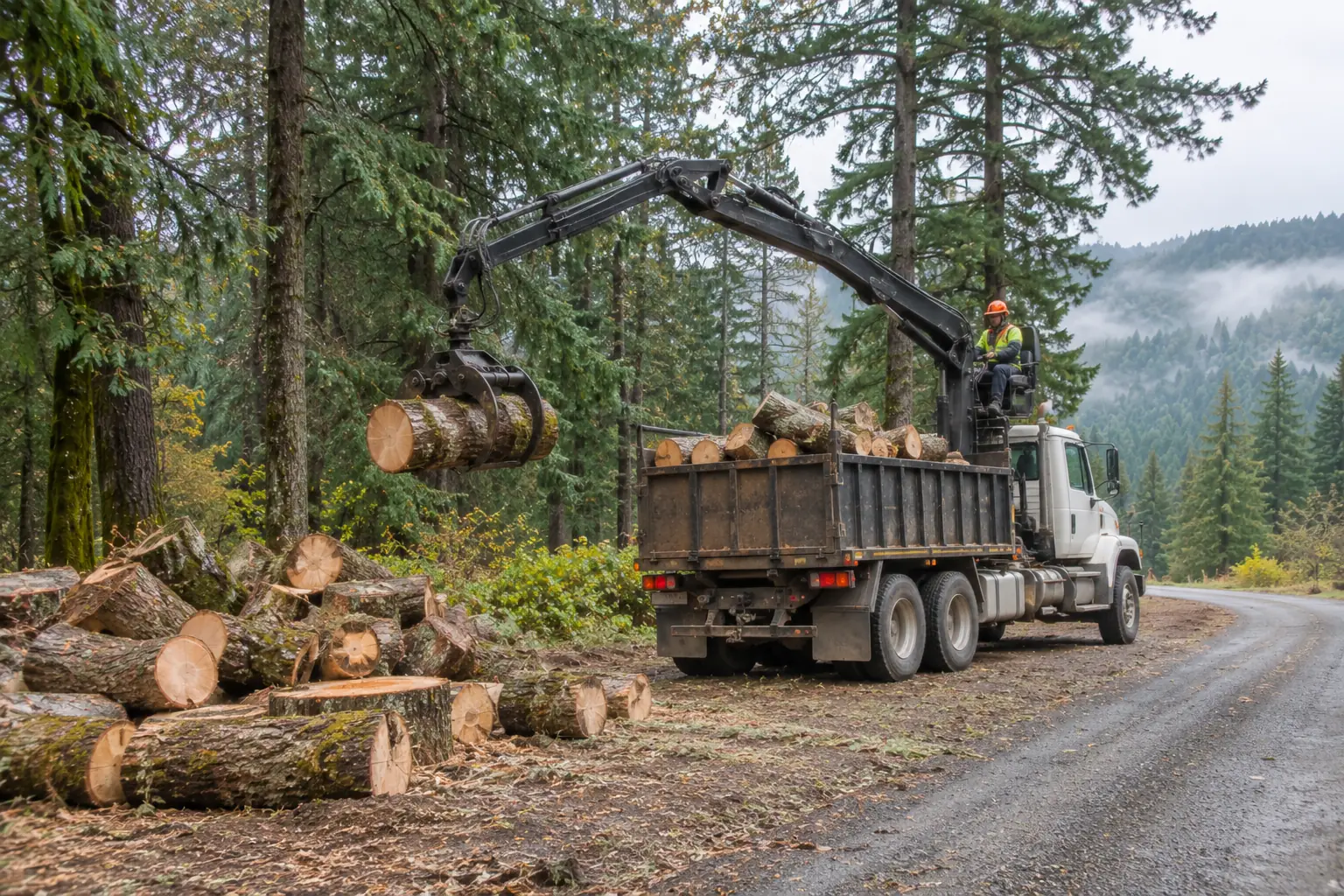
Winter storms are the usual cause in Josephine County. Saturated soil lets shallow-rooted trees tip over, and wet snow or ice can snap tops out of conifers. After a storm, take photos before anything is moved, call your insurer and keep every receipt.
For anything touching a power line, follow Pacific Power's storm safety advice: keep 35 feet or more between you and the wire, assume a downed line is live, call 911, and only then Pacific Power on 1-877-508-5088. The utility uses that one number for wires on the ground, trees against a line and outages alike. No tree crew should start until Pacific Power has dealt with the wire.
Pacific Power also handles trees near its own lines. Its vegetation management page says homeowners should never prune or remove trees near power lines, that the utility prunes around distribution lines at no cost, and that it can cut power to the wire feeding a house for a while, free of charge, so a tree job can go ahead safely. Ask for that well before the work date. The storm and emergency work page covers the steps to take right after a tree comes down.
Permits and street trees inside Grants Pass
Inside city limits, any tree on public or semi-public land needs a city permit before it is planted, pruned or removed. That includes street trees in the strip between the sidewalk and the curb. The city's tree permits page lists these points:
- The permit is free.
- Only a contractor the city has prequalified may work in the public right of way, and that list is limited to contractors holding ISA certification.
- A removal or pruning permit is filled out by the prequalified arborist with the landowner's consent.
- Questions go to the city's urban forester through the city at 541-450-6000.
The city's urban forestry page adds that upkeep of right of way trees beside a lot falls to the owner of that lot. Tree rules for development are in Article 23 of the city's development code, so ask the city before removing trees on a lot you plan to build on.
There is also help with the cost of dangerous street trees. Under the Hazardous Tree Program, the city reimburses up to half the cost of removing a hazardous tree in the right of way, grinding its stump and planting a replacement. The owner collects three or more written bids from arborists on the approved list, sends them to the city for approval, gets the permit and then submits receipts after the new tree is planted. The program does not cover trees on private land. The Grants Pass tree permits guide walks through each step.
Outside city limits: fire season and defensible space
Most of the area around Grants Pass is rural, and between late spring and autumn the bigger concern there is fire. The Oregon Department of Forestry's Southwest Oregon District sets the rules for saw work on the lands it protects, and they shift as the fire danger rating moves from day to day.
The district's 2026 regulated closure, in effect from May 15, 2026, spelled out the limits for power saws:
| Danger rating | When saws may run |
|---|---|
| Green, low | Any hour |
| Blue, moderate | Until 1 p.m., then again from 8 p.m. |
| Yellow, high | Until 10 a.m., then again from 8 p.m. |
| Red, extreme | Banned |
Every saw on site must have its own shovel plus an extinguisher holding eight ounces or more, and a fire watch lasting an hour or longer follows each saw's use. The rule counts battery and corded saws the same as gas ones. Backyard debris burning is banned throughout fire season. Check ODF's fire restrictions page for the current level before any work is booked.
Commercial operations on forest land also follow Industrial Fire Precaution Levels. Level II limits most power saw use to the hours from 8 p.m. to 1 p.m., and Level IV shuts down every operation. A tree company working on a wooded parcel should know which level applies.
The cooler months are the time to get ready. The Oregon State Fire Marshal's defensible space page divides the ground around a house into three zones: the first 5 feet, the band from 5 out to 30 feet, and everything from 30 feet out to 100 feet or beyond. Its advice includes keeping a gap of 10 feet or more between tree crowns and removing limbs up to 6 feet above the ground, and it offers a free defensible space assessment. The Josephine County defensible space guide explains how a tree service can help with each zone.
Oaks, mistletoe and the trees of the valley
Grants Pass sits where conifer forest meets oak woodland, so a tree crew here may prune a ponderosa pine or a Douglas fir in the morning and an Oregon white oak or a madrone after lunch. Each one needs a slightly different approach.
Mistletoe comes up constantly. An OSU Extension mistletoe guide says the leafy mistletoe found on Oregon white oak usually does little harm, though heavy infections can cause dieback and drought stress. Pruning out infected branches helps for a while, but it has to be repeated. Dwarf mistletoe on conifers is more serious. It can cause growth loss, top dieback and death, and it makes pines more open to bark beetles. OSU recommends managing it by removing same-species understory trees within 50 feet of an infected tree.
Oaks also react badly to soil changes. Trenching, grading or parking heavy equipment under the canopy can damage roots years before the crown shows it. If you are building near an old oak, bring the tree company in before the excavator. The oak tree care page and the guide to mistletoe and oak problems go into more detail.
Towns covered around Grants Pass
This referral takes requests from Grants Pass and the communities around it in Josephine County. Give your address on the call, and the company can say yes or no to the distance. Every community below links to a page with notes on access, local rules and the trees you are likely to have.
- Merlin. About 9 miles northwest of Grants Pass in the Jumpoff Joe Creek valley, close to the Rogue River.
- Murphy. A small rural community just south of the city.
- Williams. About 19 miles south of Grants Pass in the Williams Creek valley, which drains north to the Applegate River.
- Cave Junction. A city in the Illinois Valley, southwest of Grants Pass along US 199.
- Wilderville. A rural community on US 199 southwest of the city.
- Selma. Further down US 199 in the Deer Creek valley, between Wilderville and Cave Junction.
Places along US 199 such as Wilderville, Wonder, Selma, Kerby and O'Brien are named as rural communities in ODOT's US 199 corridor plan. If your road is not listed, call anyway and ask. The service areas page sorts them north, south and southwest of the city.
Grants Pass and Josephine County at a glance
Grants Pass is the county seat of Josephine County and its largest city. The 2020 census counted a little over 39,000 people in the city and about 88,000 in the county, according to U.S. Census Bureau QuickFacts.
A few facts that shape tree work here:
- The Rogue River runs through town. Riverfront lots often have big cottonwoods, maples and conifers, and work near the bank may involve extra rules. Ask the company and the city or county before cutting near water.
- Two highways meet here. US 199, the Redwood Highway, connects Interstate 5 at Grants Pass with US 101 in California, as described in ODOT's corridor plan. The towns along it share the same long drives and wooded lots.
- The city manages an urban forest. According to its urban forestry page, Grants Pass is a Tree City USA and earned Sterling Tree City USA status in 2020. It also keeps a short list of Heritage Trees named by the City Council.
- City and county rules differ. The city permit rules above apply inside city limits. Outside them, Josephine County and ODF rules matter more, so ask which applies to your parcel.
Reading before you book
Four guides answer what homeowners usually wonder about ahead of a tree job. Each one links to the official source for every rule it explains.
- Tree service cost in Grants Pass. Price ranges by job, what drives them and ways to spend less.
- Grants Pass tree permits. Street trees, permits, prequalified contractors and the Hazardous Tree Program.
- Defensible space in Josephine County. Fire-safe spacing for trees and brush around a home.
- Mistletoe and oak problems. What mistletoe and oak decline look like and what a tree service can do.
Frequently asked questions
Does Tree Service Grants Pass send out its own crew?
Tree Service Grants Pass exists only as a website plus a number to dial. It has no crew and no equipment and does no tree work. Your call is routed to a nearby, separately owned tree business that carries an Oregon CCB license. Everything after that, from the visit and the estimate to any work you hire it for, is that business's to handle.
Is there a charge for the referral?
The call and the referral are free to you. The tree company pays this site for referrals. As for the estimate, most everyday jobs get one without a fee, though that is up to the company and worth a question when you phone. You pay only the company, and only for work you agree to in its written estimate.
How much does tree service cost in Grants Pass?
National guides put trimming one tree at about $430 to $640 and a typical removal at about $385 to $1,070, with tall or tricky trees costing more. Local prices vary, so the quote written after an in-person visit is the figure to trust. The cost guide has more ranges and dates.
When does Grants Pass require a tree permit?
A free city permit is required for any tree in the public right of way, such as a street tree, and only a prequalified contractor may do that work. Trees elsewhere on private property follow different rules, and lots being developed fall under the city development code. Confirm with the city before work starts.
Can tree work be done during fire season?
Much of it can, within limits. On lands protected by ODF, power saw hours depend on the daily fire danger, and saws are banned when the danger is extreme. Check ODF's current restrictions, and plan big jobs for the cooler months when you can.
A tree came down on electric wires. Now what?
Keep yourself and everyone else 35 feet or more from it. Call 911. Pacific Power is the second call, on 1-877-508-5088, since the utility has to clear the hazard before any tree crew touches the tree.