A hazard tree check in Grants Pass is a close look at a tree to judge how likely it is to fail and what it would hit. Dialing (541) 291-5564 sends your details to one independent tree service near Grants Pass that holds an Oregon CCB license. Ask for the check to be done by an ISA Certified Arborist, ideally one who also holds the tree risk qualification.
What a tree risk check looks at
A risk check weighs two things together: the chance that the tree or a limb breaks, and what is underneath it. A cracked limb over an empty pasture and the same limb over a bedroom are very different problems.
The person checking will usually walk around the tree, look at the root flare and soil, sound the trunk with a mallet, scan the crown for dead wood, and note the buildings, driveways, play areas and wires within reach. The International Society of Arboriculture runs a credential for this work called the Tree Risk Assessment Qualification, or TRAQ. ISA's TRAQ application guide says the course covers limited-visual and basic assessments and the principles of advanced diagnostic methods, and that the qualification is valid for seven years before the holder must retrain and retest.
| Assessment level | What happens | When it is used |
|---|---|---|
| Limited visual | A quick look from the ground or a vehicle for obvious defects | Many trees along a road, fence or property edge |
| Basic | A walk around one tree, with simple tools such as a mallet and probe | Most single trees near a home |
| Advanced | Extra tools or climbing to measure decay or look at the upper crown | A high-value tree, or when a basic check leaves questions |
Signs you can see from the ground
You do not need training to notice most early warning signs. Write down what you see, take photos and mention them when you call.
| What you see | What it can point to | How soon to call |
|---|---|---|
| A new lean, or soil heaved up on one side of the base | Roots failing or the root plate lifting | Right away if it could reach a house |
| A crack through the trunk or where two big stems meet | A split that can open in wind or snow | Soon |
| Mushrooms or shelf fungus at the base or on the trunk | Possible decay inside | Within a few weeks |
| Dead branches high in the crown, or a crown thinning from the top | Drought stress, root problems or insects | Within a few weeks |
| Fine boring dust in bark cracks, or small holes and pitch tubes | Bark beetles or wood borers | Soon, before they spread |
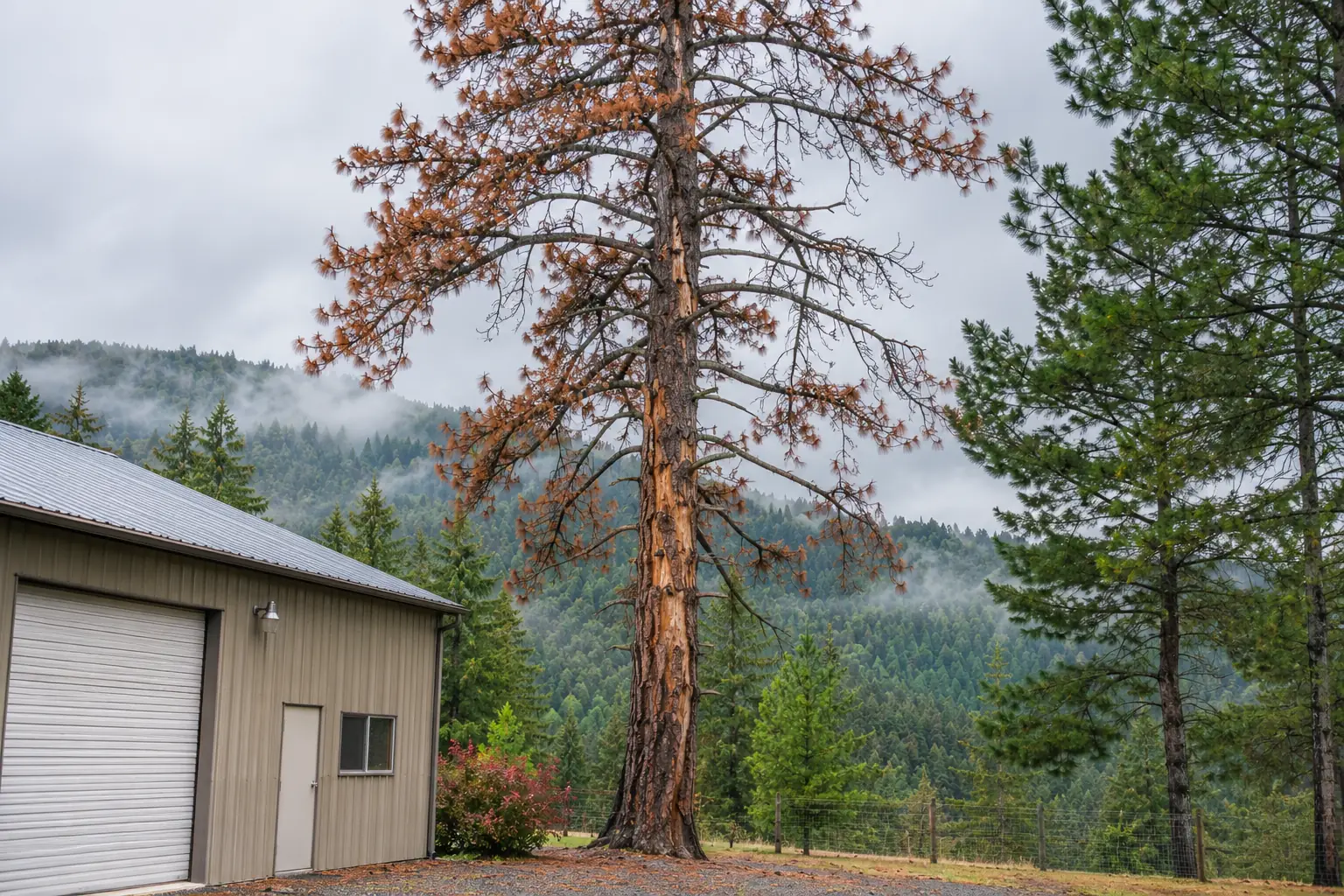
| A pine with a red or faded top third | Possible Ips beetle attack | Soon |
| Bark falling off in sheets | A tree that has been dead for some time | Soon if it stands near a target |
The table is a starting point, not a diagnosis. OSU Extension's Why Are My Trees Dying?, revised July 2025, says clear or white pitch means a conifer is fighting back and may recover, while reddish pitch points to more damage. It also notes that reddening needles often show up after the insects have already left.
Why so many local trees are failing
Hot drought has hit conifers in southwest Oregon hard, and that shows up in hazard checks around Grants Pass. Two problems come up often.
Douglas-fir decline. OSU Extension's Trees on the Edge, published September 2023, says Douglas-fir deaths in Jackson, Josephine and Douglas counties rose sharply after 2015. Aerial surveys estimated about 260,000 trees killed and nearly 150,000 acres affected from 2016 to 2019. The publication names water-stressed sites, hot drought and the flatheaded fir borer as the main drivers, with the worst losses on warm, dry, low to mid elevation sites.
Pine engraver beetles. The Oregon Department of Forestry's Ips beetle fact sheet, from April 2021, says death of the top third of the crown is often the first clear sign of attack, and that by the time the top of a large pine turns red the tree is often lost. It says outbreaks usually follow years when April through July rain is 25 percent below normal, and that the beetles breed first in fresh pine slash 3 to 8 inches across.
A dead pine or fir near a shop, house or road does not get stronger with time. Dead wood dries, cracks and drops limbs, and it is more dangerous to climb the longer it stands.
What you get from a hazard check
A good check ends with a clear recommendation and the reason for it. Ask for that in writing, not only by voice.
Possible outcomes include leaving the tree alone and checking it again later, removing dead limbs, reducing the weight of a heavy limb, moving a target such as a parking spot or a play set, or removing the tree. If the company recommends removal, ask what it saw that ruled out pruning. If the tree is worth keeping and the question is close, ask whether an advanced assessment would help. Keep the report. It is useful for insurance questions, for a neighbor conversation, and for the next check.
What a tree risk check costs
Some tree services look at a tree for free as part of a removal or pruning estimate, while a written arborist report is a paid service. Published guides give a rough range.
LawnStarter's arborist cost guide, updated October 9, 2026, lists:
| Service | National range |
|---|---|
| Tree inspection | Free to $250 |
| Consultation and estimate work | $75 to $250 per hour |
| Written arborist report | $250 to $400 |
These are national figures, not Grants Pass quotes. A large property with many trees, or an advanced assessment with special tools, costs more. Ask before the visit whether the fee is credited toward any work you hire the company to do. The written estimate from the company is what counts, and the tree service cost guide compares this with other jobs.
Grants Pass rules for hazard trees
The City of Grants Pass puts the duty to deal with a hazard tree on the owner of the land. The rules differ for yard trees and street trees.
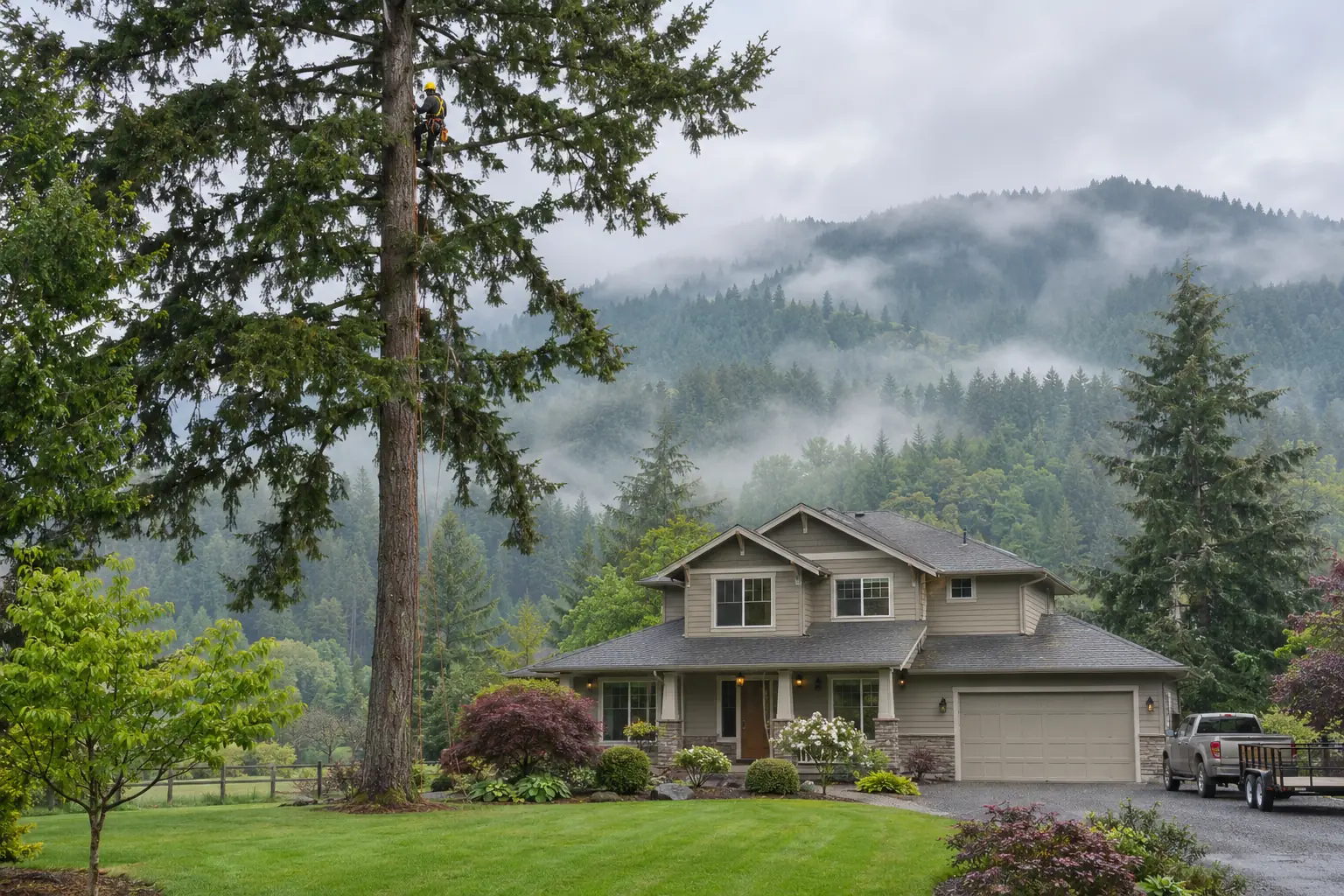
For private land, the city's tree code (Title 10) says no person shall keep a tree on their land that is a hazard to people or property. For trees in the public right-of-way, the city's Hazardous Tree Program says that when city staff decide a tree is hazardous, the owner must remove the hazard. The city may pay up to 50 percent of removal and replacement when funds are available, after the owner submits at least three written bids from approved arborists. If the work is not done, the program page says the city can remove the tree itself and place a lien on the property for the cost plus a 20 percent administrative fee. A payment plan may be possible in cases of hardship.
The removal of a street tree needs a free city permit, done by a city-prequalified arborist contractor, as the tree permit page explains. Call the city at 541-450-6000 with questions. The Grants Pass tree permits guide covers the paperwork.
Hazard trees near power lines
If the tree that worries you stands near overhead wires, call the utility before anyone else. A failing tree near a line is a job for Pacific Power's crews or contractors first.
Pacific Power's vegetation management page says customers can ask for an arborist evaluation to learn which lines cross their property and whether a tree is a concern. It also says the utility may mark trees that threaten safety or reliability for removal and tries to get the owner's written permission first. The number for requesting that evaluation is 1-888-221-7070. A tree service can then handle the parts of the job away from the wires. If the tree has already gone over onto a line, skip the evaluation. Get 35 feet from it, call 911, and give Pacific Power the location on 1-877-508-5088.
Choosing who checks the tree
The person who checks your tree should be able to explain what they saw in plain words. Credentials help you judge that before the visit.
- Ask whether the person doing the check is an ISA Certified Arborist, and whether they hold TRAQ. ISA's find an arborist directory lets you look up credential holders.
- Ask for the company's Oregon CCB license number and check it on the CCB license search, or call 503-378-4621.
- Ask whether you will get a written summary or a formal report, and what each costs.
- If the same company would also do the removal, ask it to show you the defect that drives the recommendation.
Hazard checks on rural lots
On acreage outside town, a check often covers many trees at once, especially firs and pines near a house, shop, barn or long driveway. Fire season rules can also decide when a removal can be scheduled.
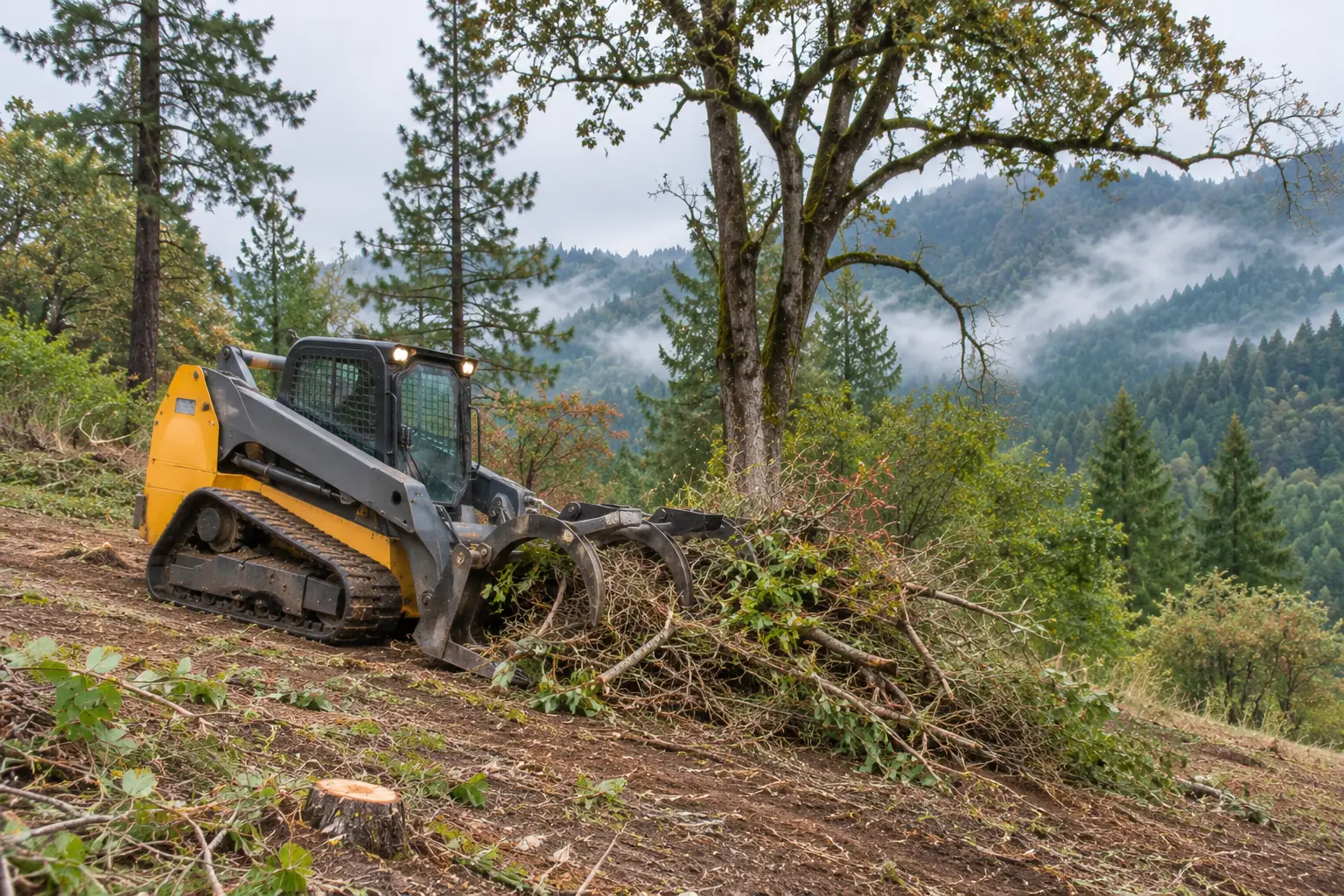
The tree removal page explains the saw rules and removal methods. If the tree is native oak, the oak tree care page covers mistletoe and oak decline. If a tree has already cracked or fallen, go straight to storm and emergency work. Town pages include Merlin and Cave Junction, and the home page explains this referral service.
Frequently asked questions
Can a tree look healthy and still be a hazard?
A tree can have full green leaves and still have decay in the trunk or roots, a weak fork, or a crack hidden by bark. That is why the check includes the base, the trunk and the crown, not only the leaves.
What is the difference between an arborist and a tree service?
An arborist is a person trained in tree care, and the ISA Certified Arborist credential shows that the person passed an exam and keeps up continuing education. A tree service is a business that does tree work. Many tree services employ certified arborists; ask whether yours does.
My neighbor's dead tree leans toward my house. What can I do?
Talk with your neighbor and share what you see. The city's tree code says no one may keep a hazard tree on their land. For trees in the right-of-way, call the city at 541-450-6000. For questions about who is responsible, check with the city or a lawyer.
Does every dead tree need to come down right away?
Not every one. OSU Extension's Trees on the Edge suggests keeping some large dead trees, called snags, for wildlife, which makes sense only where one cannot hit anything if it falls. A dead tree that can reach a house, driveway, road or wire should be checked soon, because dead wood weakens over time.
Will the city help pay for my backyard hazard tree?
The city's 50 percent program covers hazardous or dead trees in the public right-of-way, not trees wholly in a private yard. Read the program page or call the city to confirm whether your tree qualifies.