
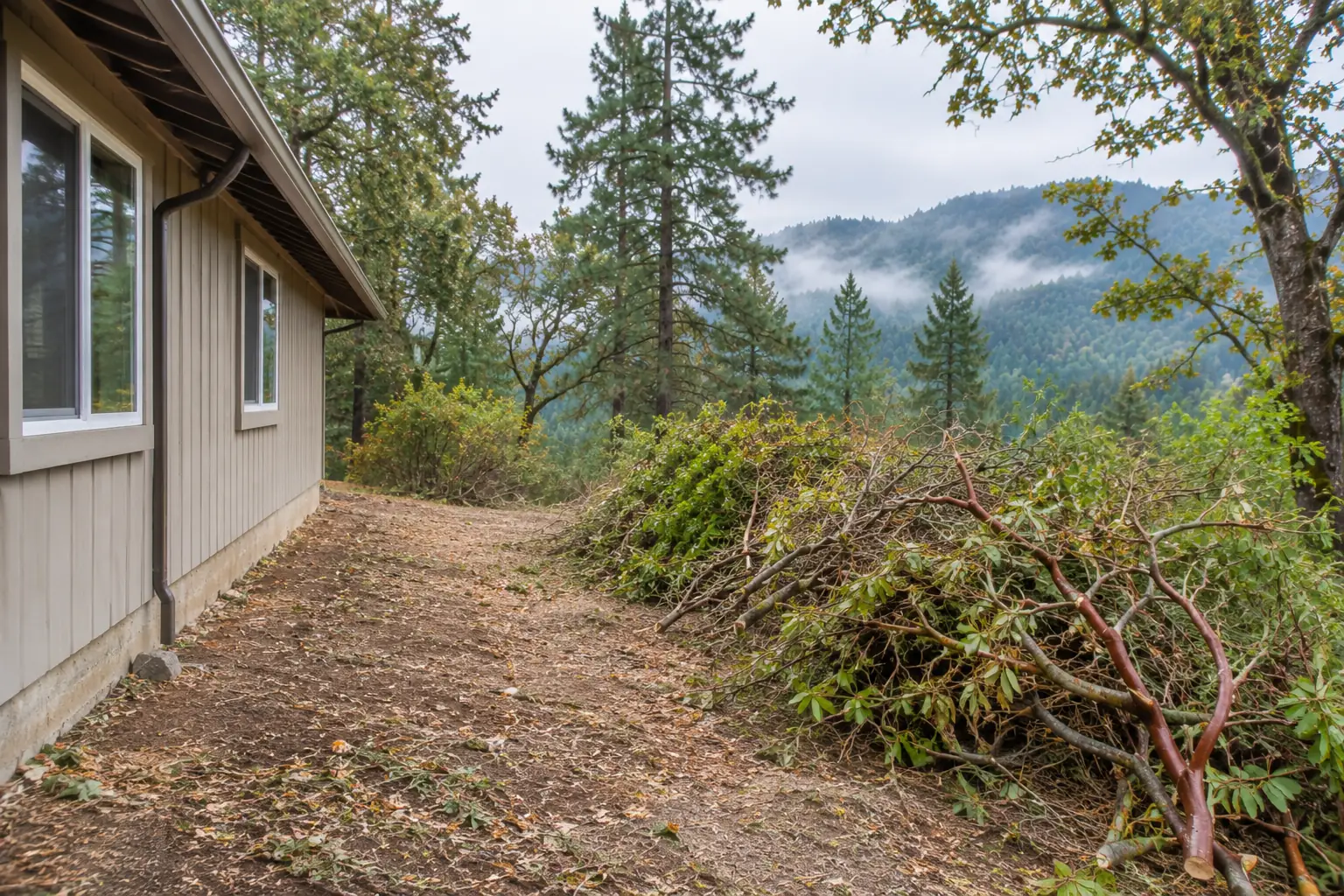
Defensible space around a Josephine County home starts with a 5-foot strip of rock or bare ground next to the house, 10 feet or more between tree crowns, lower limbs cut up to 6 feet and the brush under them cleared, per the Oregon State Fire Marshal. A tree service can handle the big cutting. Dial (541) 291-5564 to reach one, and settle on that call whether the estimate is free.
Where Oregon's defensible space rules stand
For most Josephine County homes, defensible space is strongly advised but not required by a statewide rule as of late 2026. Older articles may be out of date.
In 2025 the Legislature passed Senate Bill 83, which repealed the statewide wildfire hazard map and the building code and defensible space requirements tied to it. The bill directed the State Fire Marshal to write a model code instead. On May 19, 2026, the Fire Marshal announced the finished model code, which cities, counties and fire agencies may adopt if they choose. Ask your city or fire district whether it has adopted the code before you assume any rule applies to you.
One older state law still matters on some rural lots. The Oregon Forestland-Urban Interface Fire Protection Act of 1997, often called SB 360, covers residential lots inside an ODF protection district that a county committee has mapped and classified. It is explained further down.
The Fire Marshal's checklist for trees, brush and the house
Specific numbers a homeowner can work from are on the Fire Marshal's defensible space page, which splits the yard into an immediate zone out to 5 feet, an intermediate zone to 30 feet, and an extended zone beyond that to 100 feet and farther.
| Item | Fire Marshal guidance |
|---|---|
| First 5 feet from the house | River rock, gravel or pavers. No bark mulch or flammable plants such as junipers. Clear debris under decks and patios. |
| Space between tree crowns | 10 feet or more |
| Lowest branches | Limbed up to 6 feet |
| Brush under trees | Remove ladder fuels, plus heavy ground litter and deadwood |
| Grass | Mowed under 4 inches |
| Roof and gutters | Clear of leaves, needles and debris |
| Propane tanks | 10 feet of clearance |
| Driveway | 13 feet 6 inches of vertical and 20 feet of horizontal clearance for fire engines |
| Vents | Covered with 1/8-inch metal mesh |
Ladder fuels are the shrubs, small trees and low limbs that let a ground fire climb into the crowns, such as young firs and brush under mature pines and oaks. Removing them leaves the big trees standing.
ODF fuel break rules on forestland-urban interface lots
If your lot falls inside a classified forestland-urban interface area, SB 360 asks you to build a fuel break around the house and along the driveway. The Oregon Department of Forestry's brochure 6 Steps to Wildfire Protection sets out the steps for lots classified "high."
- A fuel break around the house. It is 30 feet wide when the roof is a fire-resistant Class A, B or C, and 50 feet when it is cedar shakes or another flammable material. It is measured along the slope from the farthest part of the house, such as the eave or an attached deck, and it does not have to go past your property line.
- A clear driveway. On a driveway at least 150 feet long, keep 12 feet of horizontal and 13 1/2 feet of vertical clearance over the driving surface, with a fuel break 10 feet out from each side of the centerline.
- Branches away from the chimney. Trim all branches 10 feet back from a chimney that vents a wood stove or fireplace.
- Nothing dead over the roof. Remove every dead branch overhanging the roof, and clear needles and leaves from the roof and gutters.
- Clean under decks and stairs. Remove stored wood and dry litter from these spaces.
- Firewood and lumber at a distance. During fire season, keep piles at least 20 feet from any structure.
Inside the fuel break, trees and shrubs should stay green, mostly free of dead material and spaced so fire cannot jump from one to the next. They apply to structures of 500 square feet or more. Each lot carries one of four classifications, low, moderate, high or extreme, and each requires a different level of fuel reduction. ODF mails a certification form to owners in these areas. The brochure says there is no fine for not doing the work, but an owner who has not returned the form can be billed up to $100,000 in suppression costs if a fire starts on the property and spreads through the area that should have been treated. To learn your classification, call the ODF Grants Pass Unit, listed on ODF's office map at 541-474-3152.
You do not have to clear-cut to be fire safe
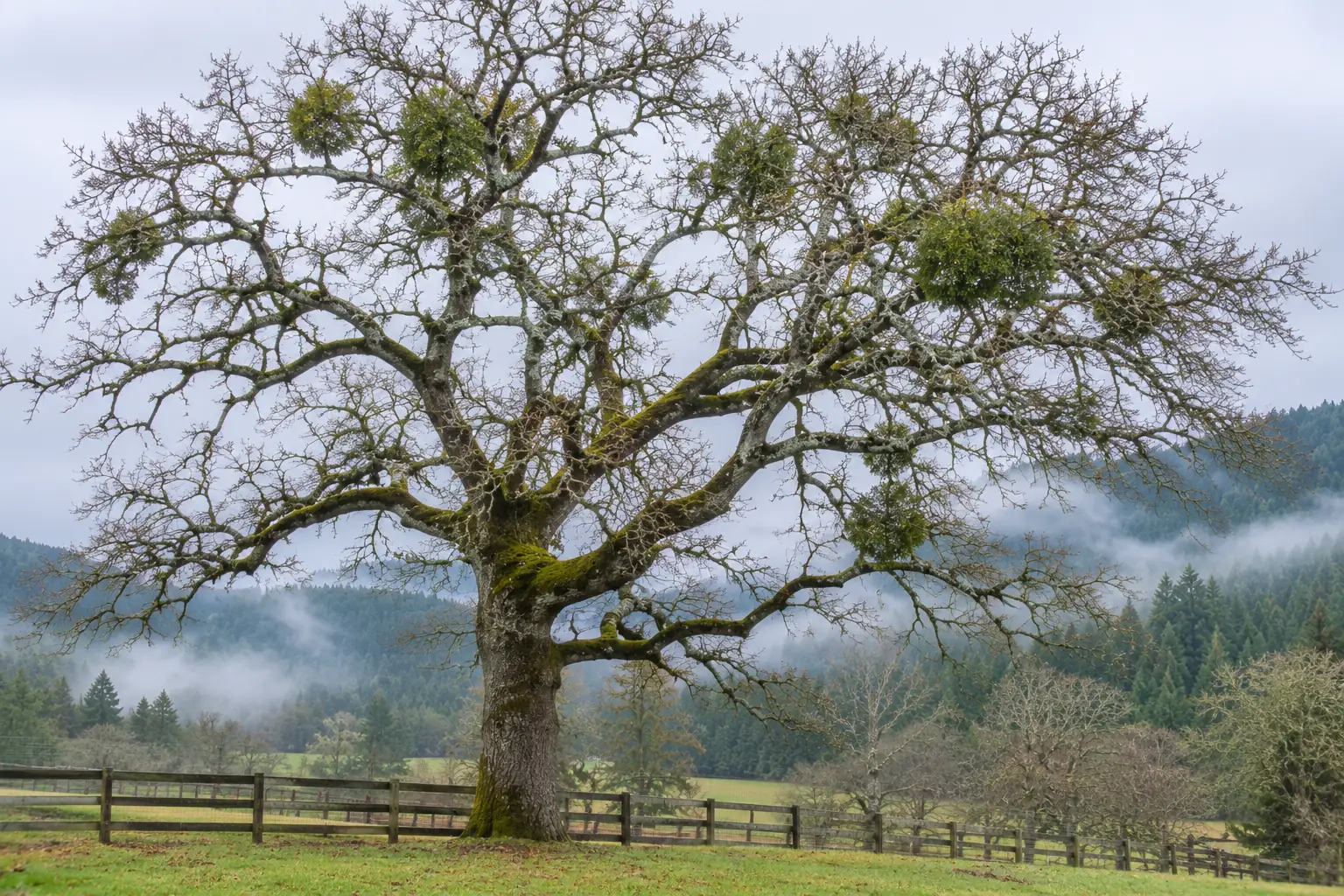
Good defensible space keeps most healthy big trees. The same ODF brochure says trees can shield a home from radiant heat and embers, that some thinning may be needed, and that it is generally wise to keep the oldest trees if they are healthy. It also suggests talking with an ODF fire prevention specialist before removing healthy mature trees.
In practice, the work is often modest: thin crowded young trees, limb up the keepers, clear branches from the roof and chimney, and remove dead trees near the house. The brush removal page covers clearing manzanita, poison oak and scrub, and the tree trimming page covers limbing and crown thinning.
Dying Douglas fir and dead trees near the house
Dead conifers close to a home are among the most urgent fire problems in this county. Oregon State University Extension's Trees on the Edge, published September 2023, explains why so many are dying.
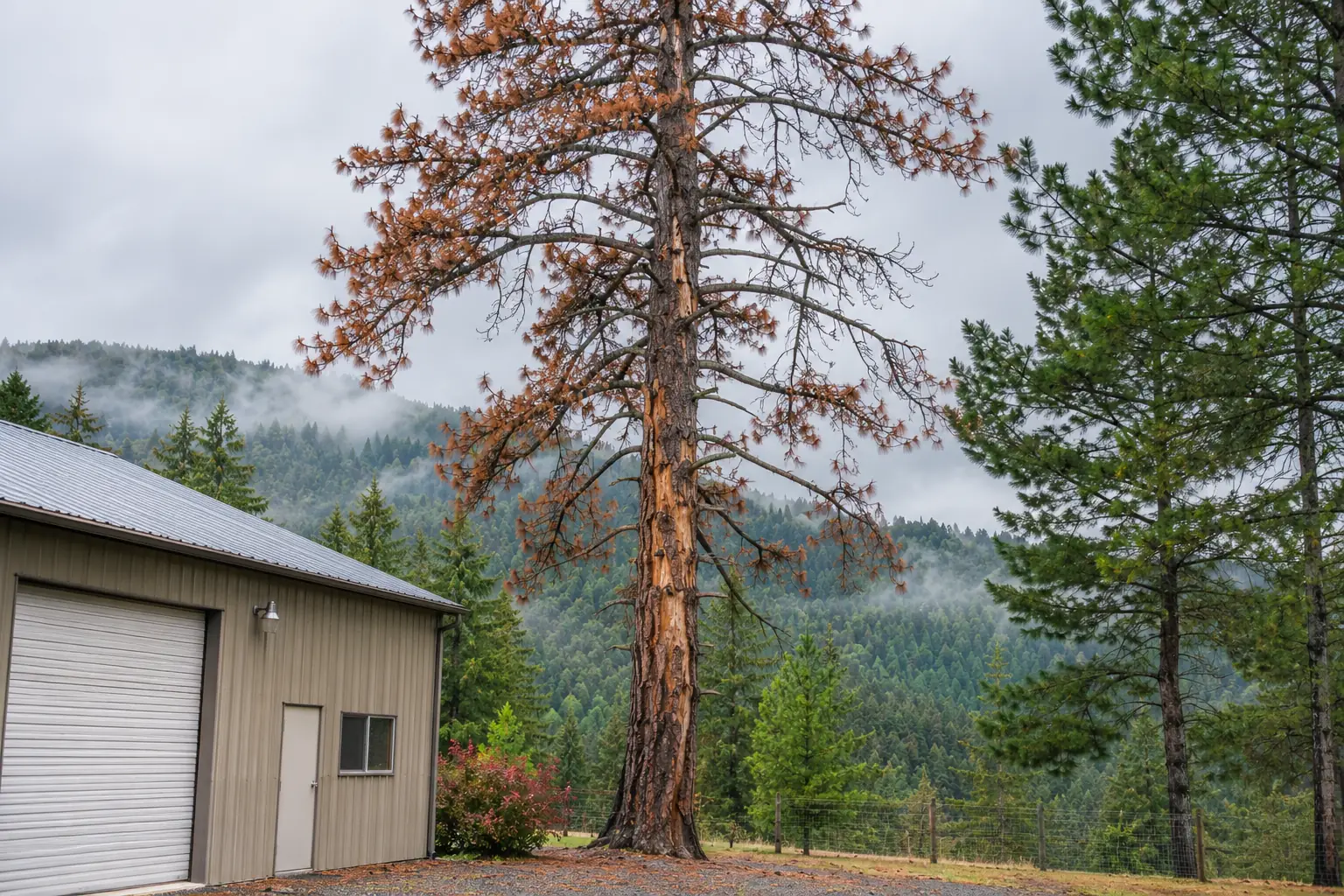
The publication says Douglas fir dieback is concentrated in Jackson, Josephine and Douglas counties, and that aerial surveys from 2016 to 2019 estimated about 260,000 trees killed across nearly 150,000 acres, in cases tied to the flatheaded fir borer. Hot drought and stressed sites drive it, and areas with under 35 inches of average yearly rain and below 3,500 feet in elevation face the highest risk. Freshly dead trees with red needles are described as extremely flammable for a few months to a couple of years. After the needles drop, fallen wood builds up surface fuel for about a decade. The publication favors acting early, shifting toward drought-tolerant trees such as ponderosa pine, incense cedar and hardwoods, and leaving a few large dead trees per acre for wildlife where they are safe. Near a house, a dead tree is better checked soon. See hazard tree checks and tree removal in Grants Pass.
When to schedule saw and brush work
The easiest time for fire-safety tree work is late fall through spring, after fire season ends and before the next one starts. Summer rules make the work slower and limit what can happen to the brush.
ODF's 2026 regulated closure for southwest Oregon, effective May 15, 2026, applied to the regulated use areas of ODF's Southwest Oregon district and to forestland within an eighth of a mile. Saws, including battery and electric ones, could run any time at low (green) danger. At moderate (blue) they had to stop from 1 p.m. until 8 p.m., at high (yellow) from 10 a.m. until 8 p.m., and at extreme (red) they were banned outright. Every saw had to have a shovel and an extinguisher holding 8 ounces or more on hand, and someone had to stay and watch for fire for an hour once cutting stopped. Backyard debris burning was banned all season. Josephine County also prohibits all outdoor burning during fire season, and its burn advisory page showed the 2026 season ending October 28. For daily burn information outside fire season, the county's recorded number is (541) 476-9663. In summer, plan to chip or haul brush.
Wires in the trees
Leave any tree that touches or overhangs a power line to the utility or a qualified crew. Pacific Power's vegetation management page warns that contact with a line can be fatal and says the utility hires arborists to keep a safe corridor around its lines.
Call Pacific Power at 1-888-221-7070 about a tree near its lines. The same page says Pacific Power can provide a free temporary disconnect of your service line when tree work near it needs one, so a licensed company can work safely around the wire to your house. If a tree is down on a line, move everyone 35 feet off, call 911, and tell Pacific Power next, on 1-877-508-5088.
Free help before you hire anyone
Several public agencies give free defensible space advice, though not tree work.
- Oregon State Fire Marshal. The defensible space page offers a free, education-focused assessment you can request online.
- ODF Grants Pass Unit. Staff can explain SB 360 classifications and fuel reduction standards at 541-474-3152.
- OSU Extension, Josephine County. The county Extension office at the Rogue Community College Redwood Campus can be reached at 541-241-3050 for tree and forestry questions.
What to ask a tree service about fire-safety work
These questions help you compare companies before a fire-safety job starts.
- What is your CCB license number? You can check it on the Oregon CCB license search.
- Which trees do you plan to keep, and why?
- How high will you limb the trees, and how far apart will the crowns end up?
- Where will the brush and wood go, and will you chip it on site?
- If the work runs into fire season, how will you follow ODF's saw hours and fire watch rules?
For how the free call works, see the Tree Service Grants Pass home page. Prices for this kind of work are in the tree service cost guide.
Frequently asked questions
Is defensible space required by law in Josephine County?
As of late 2026, no statewide rule requires it for most homes. SB 83 repealed the state's map-based requirements in 2025, and the Fire Marshal's 2026 model code applies only where a local government adopts it. Lots in a classified forestland-urban interface area fall under SB 360's fuel break standards.
What spacing does the Fire Marshal suggest for trees near a home?
Keep 10 feet or more between neighboring crowns, limb trees up to 6 feet and clear the brush beneath them. Inside an SB 360 fuel break, trees should also be arranged so fire cannot jump from one to the next.
Do I have to cut down my big pines and oaks?
Usually not. ODF says trees can protect a home from heat and embers and that keeping the oldest healthy trees is generally wise. Most fire-safety work thins small trees, removes brush and dead wood, and limbs up the trees that stay.
Can I burn the brush after a tree service clears it?
Not during fire season. Josephine County prohibits all outdoor burning then, and ODF's closure bans backyard debris burning. Outside fire season, call the county's burn advisory number, (541) 476-9663, before you burn, or have the brush chipped or hauled.
Can a tree service run chainsaws in August?
Often, but with limits on and near ODF-protected land. In 2026, saws were allowed only in the cooler hours at moderate and high fire danger, banned at extreme danger, and each one needed a shovel, an extinguisher and an hour-long fire watch afterward.