Before any tree service plants, prunes, removes or grinds the stump of a tree on public or semi-public land in Grants Pass, the city must approve a tree permit. That covers most planting strips between curb and sidewalk. The permit is free. Trees fully on private land usually need none, apart from the city's six Heritage Trees.
Is your tree public, semi-public or private?
Where a tree is rooted decides which rules apply. Title 10 of the Grants Pass municipal code sorts trees by the land under them.
Land the city owns, such as a park, is public property. Semi-public property is ground where the city has the legal right, through an easement or a street right-of-way, to control how trees there are planted, cared for and taken out. A tree on either kind of ground is a public tree in the code's terms. On its urban forestry page, the city says the right-of-way is usually the strip from the curb back to the sidewalk, and that keeping up the trees in it falls to the landowner. For code purposes, a tree is a woody plant that grows to six feet or taller.
| Where the tree stands | City tree permit? | Who may do removal or major pruning |
|---|---|---|
| City park or other city land | Yes | The city, or a contractor it approves |
| Planting strip or other right-of-way | Yes, free | A city-prequalified contractor with ISA certification |
| Private yard, not a Heritage Tree | Generally no city tree permit | Any company you hire (check its Oregon license) |
| Designated Heritage Tree, any land | Yes, Heritage Tree permit | Work done by or under an ISA-certified arborist |
| Outside city limits | No city tree permit | See the county section below |
Not sure whether the tree out front sits in the right-of-way? Ask City Hall, 541-450-6000, before booking anyone.
The two city permit forms
Grants Pass has one form for taking out or pruning a tree and another for planting only. Its tree permits page charges nothing for either.
The first form handles every kind of removal, hazardous or not, along with pruning and stump work. The planting form is for adding a new right-of-way tree that is not a replacement, and an owner can complete it alone. According to the removal or pruning application, nothing can start until the city signs off, and it turns down forms with blanks. Send back pages 5 and 6, either by email to tree@grantspassoregon.gov as a PDF or photos, or on paper to City Hall at 101 NW A Street, marked "Tree Permit Application" on the envelope.
Pruning a street tree yourself
Light pruning of a planting strip tree is something an owner can do, as long as a permit is in hand first. The form allows it only when all three of these hold.
- No branch you remove is thicker than 3 inches anywhere along it.
- You take off a quarter of the tree's structure or less.
- You stay within ten feet of the ground for every cut.
Break any of the three and the job belongs to a prequalified arborist, who also fills out the form. Topping and pollarding are off the table under the form, and the code lets the city allow topping only on storm-wrecked trees or certain trees under utility wires. The tree trimming page describes what good pruning looks like.
When a prequalified arborist has to do the work
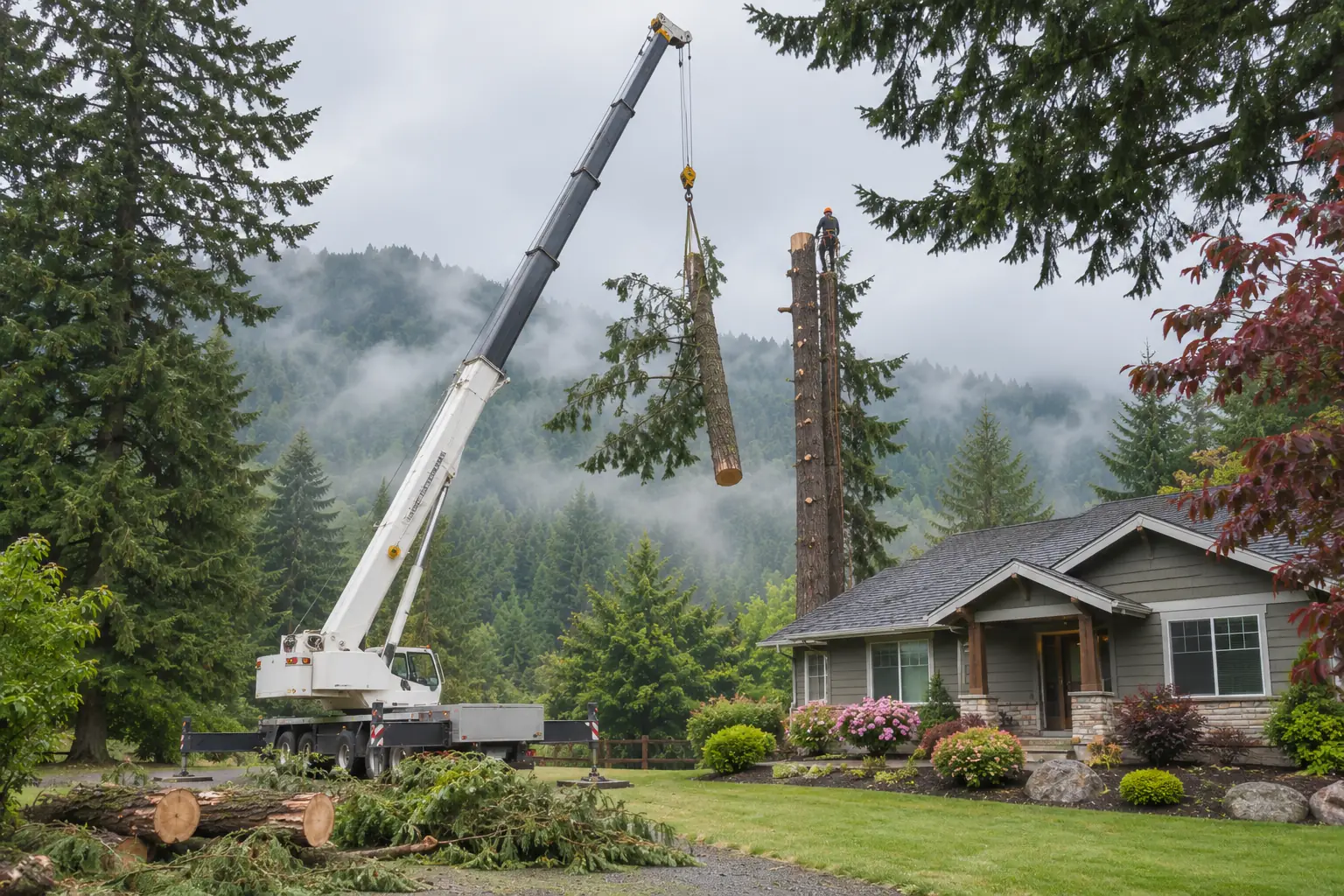
Removing any public or semi-public tree, or pruning beyond the owner limits above, takes a contractor the city has prequalified.
Under section 10.01.900, nobody may make a business of cutting, treating or taking down trees on city or right-of-way land without ISA certification and liability insurance the city has on record. The roster attached to the application, dated November 18, 2026, listed eight firms. The city says it would like more, and ISA-certified companies missing from the roster can use the prequalification page to apply.
Calling (541) 291-5564 connects you with an independent company that holds an Oregon CCB license. Whether that company is on the city roster is a separate question, so for a planting strip tree, ask first and check its answer against the roster.
What the removal or pruning application asks for
The city will not approve a form with gaps. Usually the arborist contractor fills it in and the owner adds a signature.
- Which kinds of work, and how many trees or stumps each.
- Why a tree is coming out, for example because it died or the city sent a hazard letter.
- What you will plant in its place, picked from the approved list.
- A drawing of the site plus a traffic control plan, prepared by the contractor.
- Signed consent from a neighbor if the work crosses their land.
Getting buried lines marked through 811 stays the applicant's responsibility, the form notes.
Replacement trees and stumps
Taking out a planting strip tree means putting a new one in. You get four months, or a later date the city agrees to in writing. Miss it, and the city plants the tree and sends you the bill.
The new tree has to measure one and three-quarter inches across or more, taken six inches up from where the trunk flares, and it must come off the approved species list. Examples on that list include Persian ironwood, black tupelo, Chinkapin oak, ginkgo and ponderosa pine. Trunks need room: 25 feet from intersections, 20 from streetlights, 10 from hydrants and water meters, and 5 from utility poles and driveway edges. Poplars, willows, cottonwoods, tree of heaven and any fruit or nut tree are not allowed in semi-public strips. Stumps left on public or semi-public land count as a public nuisance in the code, so the stump goes too. See the stump grinding page.
Hazardous street trees and the 50/50 program
If a planting strip tree turns dangerous, section 10.01.700 puts the cost of removing it on whoever owns the land it grows from. A city cost-share can take some of the sting out.
Per the Hazardous Tree Program page, the city pays back as much as half of what it costs to remove a hazardous right-of-way tree and its stump and plant a replacement. The application adds that this depends on money being available. The first step is a free city inspection. When a tree qualifies, you gather three or more written bids from approved arborists for the City Streets Division, get the work done under a permit before the city's deadline, replant and then submit receipts. Owners who let the deadline pass can see the city cut the tree itself and attach a lien covering its cost and an extra 20% fee. For hardship cases, the program page mentions payment plans. Healthy trees removed by choice get no reimbursement. To judge whether a tree is failing, see hazard tree checks in Grants Pass.
Heritage Trees
Heritage Trees are the exception to the rule that private trees sit outside city control. Chapter 10.02 covers every tree the City Council has named a Heritage Tree by resolution, public or private, and the urban forestry page puts the count at six.
The city hands out a Heritage Tree pruning permit the day you apply, unless the work ties into a building or development permit, and an ISA-certified arborist must do or oversee the cutting. Trimming branches no thicker than 3 inches and no higher than ten feet is treated as routine upkeep. Taking off over a quarter of the tree, in one go or bit by bit, is treated as removal, which needs its own permit and mitigation. A Heritage Tree that is cracked, split, leaning, dead or diseased can qualify for a Hazard Tree Removal Permit, sometimes after an arborist's report.
Building sites and penalties
New construction can add more rules. Chapter 10.02 points to separate significant tree preservation standards in the Development Code for development sites, so talk to the Community Development Department before any clearing. The lot clearing page covers the tree side of site work. Cutting a public tree with no permit is a violation under section 10.01.925, every day it goes on is counted again, and the city can fine the owner or abate the problem as a nuisance.
Outside Grants Pass city limits
City tree rules end at the city line. Out in Merlin, Murphy, Wilderville and the rest of rural Josephine County, the things to check are county road rights-of-way and summer fire rules.
The county's right-of-way FAQ says Public Works controls the whole width of a county road right-of-way, often far wider than the pavement, and that work there needs a permit from the agency in charge. If a tree near a county road might be in that strip, phone Public Works at (541) 474-5460 first. The defensible space guide covers fire season limits on saws and burning.
Who to call
| Question | Office | Number |
|---|---|---|
| Street tree permits, the 50/50 program, Heritage Trees | City of Grants Pass urban forestry | 541-450-6164 |
| Where your right-of-way ends, general city questions | Grants Pass City Hall | 541-450-6000 |
| Trees along a county road | Josephine County Public Works | (541) 474-5460 |
| Marking buried utilities before digging | Utility Notification Center | 811 |
| An estimate on a private tree (ask whether it is free) | One independent tree business holding a CCB license | (541) 291-5564 |
For how a referral call works, see the Tree Service Grants Pass home page and the tree service cost guide.
Frequently asked questions
Is a permit required for a backyard tree inside Grants Pass?
In most cases, no. The permit is about public and semi-public ground, and a tree rooted entirely on your own lot normally falls outside it. Heritage Trees and trees on a site under development review are the exceptions, so check with the city if either could apply.
How much is the city tree permit?
It is free, according to the city's tree permits page. The form must still be complete and approved before anyone starts, and removals or major pruning also need a site drawing, a traffic control plan and a prequalified arborist.
May I trim my planting strip tree without a contractor?
Yes, for light work. Get the permit first, keep every cut branch at 3 inches thick or less, take no more than a quarter of the tree and stay within ten feet of the ground. Topping is never allowed.